Showing posts with label Anglicanism. Show all posts

Sunday, November 26, 2017

A Sacramental Perspective on Matthew 25:31-46

So as not to go 0 for 2017 in blog posts, I thought I would interrupt the silence and post this morning's sermon, since it is a good barometer of where I am theologically and spiritually these days.

Christ the King Sunday Year A Matthew 25:31-46

You’re going to figure this out soon enough, but the word of the day for this sermon is "perspective", meaning the where and the how we view things, our point of view, or our vantage point.  We just heard Jesus talk about sheep and goats, but let me use cats and dogs to illustrate a point about the importance of recognizing the perspective from which we view the world around us.

Dogs, like the ones on our family farm I visited over the Thanksgiving holiday, look up at you with those big brown eyes, wagging their tail, as if they are thinking to themself: “You love me, you feed me, you care for me, you take me for walks... you must be God”. Cats, on the other hand, like our dear Mellow whom we adopted from the shelter last year, look at you with those piercing eyes, thinking to themself:  “You love me, you feed me, you care for me, you pet me ... I must be God”. (Joke adapted from a sermon by Steven Sizer: www.stevensizer.com) Recognizing our perspective – the vantage point from which we look at the things around us - matters.

Today is Christ the King Sunday – the last day of the church year, before we begin a new church year with the season of Advent next week. A day that we can take a step back and look at the world from a new perspective.  A perspective which reveals to us how Christ the King is a very, very different kind of king. A perspective which shows us how Christ is a king whose crown is thorns, not jewels, A perspective which shows us that his king’s throne is a cross, not made of gold. 

A perspective revealed to us through today’s Gospel from Matthew.  A perspective which reveals how Christ is with us today.  A perspective that shows us how Christ the King comes to us today - not through all kinds of royal pageantry, but through those whom Jesus calls the least of these who are members of my family. The hungry.  The thirsty. The stranger. The naked.  The sick.  The imprisoned.

This parable, sometimes called the judgment of the nations, or perhaps more simply, the parable of the sheep at the goats, is found at the end of the 25th chapter of Matthew, the chapter we’ve been going through these past few weeks where Jesus has told a series of parables about being prepared for the day when he would return.  In the very next chapter, chapter 26, Jesus had the last supper with the disciples.  He was betrayed and arrested. He was put on trial before the high priest, then in the 27th chapter, brought before Pilate, and taken to the cross.

Today’s parable of the judgment of the nations, using the sheep and the goats as metaphors for the righteous and unrighteous, was the last parable he told before those events we remember during Holy Week.

There are probably several different perspectives from which we can look at this parable of the sheep and the goats, but I’m going to talk about three. 

One possible perspective would be to look at this parable from what I’ll call the “legal perspective” the perspective that Jesus is offering us a contract for our salvation, with a list of conditions. What kind of list?  Well, because the Christmas shopping season has begun, pardon me for bringing up Santa, but a list of things we can do to be put on the nice list, the sheep list - and not the naughty list, the goat list. Let’s see – feed a hungry person? Check.  Give a drink to a thirsty person? Check. Give clothing to a naked person? Check.  Welcome the stranger? Check. Took care of someone who is sick? Check.  Visit someone in prison? Check.  Okay Jesus, I’ve done all of those things – now fulfill your end of the deal and tell me I’m a sheep.   

Another possible perspective is what I’ll call the “save the world” perspective. What I mean by that is that from this perspective, we think that Jesus is telling us how to go out there and make his kingdom a reality here on earth in our time, and we do that by doing all kinds of great and noble and just things for other people. 

Things like feeding the hungry, giving a drink to the thirsty, etc. – I won’t mention the whole list again.  Jesus told us about the kingdom of heaven, so let’s get going on bringing it to earth by doing all these things - time’s a wasting.

The problem with those perspectives is that they are from the vantage point of what we are doing.  We need to feed the hungry, welcome the stranger, and take care of the sick to fulfill our end of the legal bargain, or we need to do these things to save the world and make the kingdom of heaven a reality here on earth by doing them.

I’m going to propose to you a different perspective – what I am going to call a sacramental perspective.  As Episcopalians/Lutherans, along with other Christian traditions which believe that God’s grace comes to us through the sacraments like baptism or communion, believe that ordinary things or objects can bring the holy to us.  They can bring Christ himself to us.  The water of baptism bring Christ to us and unite us with him in his death and resurrection.  The bread and wine bring Christ to us as they carry his body and blood for forgiveness of sin and nourishment of our souls.

In other words, the sacramental perspective reveals to us that the material world – what we can see, taste, touch, is not all there is that is material to us for our salvation – our unity with God.  Through this parable, Jesus is reminding us that each encounter with the people that we meet has the potential to be an encounter with himself.  What may seem like an ordinary event, can be a Christ event.

The week before last, I stayed several days at New Melleray Abbey, the monastery over Dubuque that I go to periodically. The monks there follow the ancient Rule of St. Benedict as the guide for their lives, and the Rule of St. Benedict recognizes how Christ comes to us through others.  One part of the Rule specifically quotes Matthew 25, when it states that “All guests who present themselves are to be welcomed as Christ, for he himself will say: ‘I was a stranger, and you welcomed me”. 

In other words, an act of hospitality, welcoming a stranger, is a sacramental event – an encounter with Jesus. A means by which Jesus Christ - the King of this very different kind of kingdom - comes to us.

A sacramental perspective reminds us that Christ’s presence in the world is not merely a past event, or a future event on the day when Christ returns.  Christ’s presence is a current event.  The face of Christ is reflected to us through the face of the hungry, the thirsty, the sick, the stranger, the imprisoned.  We are all pilgrims on the journey, and Christ visits us through the journey of others. (Adapted from a writing by Fr. Prior Joel Macul on the 20th anniversary of Christ the King Priory. www.christthekingpriory.com).
A sacramental perspective affects our mindset when we go about doing the things that Jesus spoke of, like feeding the hungry.  These aren’t just acts of charity from someone who has something, to someone who does not have something. We aren’t the kings of our little kingdoms being benevolent and merciful to those whom we provide assistance.

We are receiving far more than what we are giving because the presence of Christ the King himself is with them, whether we recognize it or not.   One of the beautiful things about this parable is how the people who were sheep and not goats did all of these things without even realizing it was the Son of Man who was with the hungry, thirsty, naked, sick, stranger, and imprisoned.

So, a sacramental perspective is not required to be a sheep and not a goat, but it does open our eyes to a new way of looking at why we do the acts of love that we do as Christians. It is a perspective that comes when, as Ephesians so beautifully puts it, the eyes of your heart are enlightened. 

The eyes of your heart.  Not the eyes in your head.  The eyes in the core of your being – the core where the Holy Spirit dwells in you because of the sacrament of baptism, the core which is nourished and fed because of the sacrament of communion.

A sacramental perspective opens the eyes of our heart to see God’s grace incarnate in water, in bread and wine.  It allows us to see the presence of Christ in the least of these. It allows us to see that the presence of the resurrected and living Christ is not merely a thing of the past or future, but a living presence right here, right now, with us.  Immanuel.

Thanks be to God. Amen.


Monday, May 2, 2016

Why I'm Sticking With the Revised Common Lectionary

Now and again, I reconnect with colleagues and look at the latest trends in the church via the sometimes controversial ELCA Clergy group on Facebook.  One subject that comes up periodically within that group is the lectionary - specifically, the Revised Common Lectionary (RCL), which is the series of readings used by churches during Sunday worship services.  The RCL has been an ecumenical success, as it is used widely by Lutherans, Episcopalians, Methodists, Presbyterians, and churches from other denominations.  Even more importantly, from my perspective, it is largely in sync with the Catholic lectionary - therefore, even though we are not yet at the point where the Eucharist is shared, we at least share in the same readings from Sacred Scripture most weeks.

As I noted in my last post (back in March, sorry- I'll try to do better!), I am now 1/2 time at an Episcopal congregation, in addition to my 1/2 time call at a Lutheran church.  Since the Episcopal Church values a common liturgy (hence, the Book of Common Prayer), it is a given that congregations use the RCL. 
Based on what I read on the ELCA Clergy Facebook page, however, it appears that in the ELCA we are far from unity in our Scripture readings at worship.  Some pastors feel free to change the readings at will, or develop their own sermon series, based on their own choice of readings.   As a Lutheran with Benedictine tendencies, you can probably guess that I'm not a big fan of that practice.  
Furthermore, a whole new lectionary has been developed by Luther Seminary, the Narrative Lectionary, and a sizable contingent of congregations appear to be using it based on what I am reading on the Facebook page.  Why was a new lectionary developed when we already have one that has been widely used in the ELCA and in our ecumenical partner churches? This is the reason given:
"Though the Revised Common Lectionary has united the church in its reading of scripture and has given much-needed structure, it doesn’t present scripture -- especially the Old Testament -- in a way that helps people to become fluent in the first language of faith. The Narrative Lectionary is an attempt to take nine months to do just that."  
When I read this statement, it made me wonder  - what is the primary purpose of Scripture reading during worship?  Are Scripture readings and sermons supposed to be like Bible studies?
No.  The purpose of Scripture reading during worship is to proclaim the mystery of the faith and the presence of Christ in our midst.  
Through the magic of Google, I found an article called "Explaining the lectionary for readers", which contains a beautiful explanation of how and why the Catholic (and therefore, RCL) lectionary readings are put together.  Although it is from a Catholic website, this language strikes me as being very much Lutheran as well, with its primary focus being on the proclamation of Christ: 
 "[W]e can think of the readings at the Eucharist as a series of concentric circles:
• at the centre is the gospel which is a recollection and celebration of the mystery of Jesus, the Anointed One;
• this recollection is given added dimensions by readings from the Old Testament: the Law (such as Genesis or Exodus), the prophets (such as Amos or Joel), the Psalms, and the Writings (such as the Book of Wisdom or the Books of the Maccabees);
• then there are the readings of the great early Christian teachers’ letters to churches, such as those of Paul.
The purpose of the readings is that, in the words of the General Instruction on the Lectionary, in accordance with ancient practice there should be a ‘re-establishing [of] the use of Scripture in every celebration of the liturgy’ and that this should be seen as ‘the unfolding mystery of Christ’ being ‘recalled during the course of the liturgical year’ 
*****
If the readings at the Eucharist are there to help unfold the mystery of Jesus Christ, then several important consequences flow from this:
• We are not reading the Scriptures simply to get a knowledge of the Bible.
• We are not reading these passages because many Christians consider reading the Bible a valuable activity in itself.
• This action is not part of a Bible Study, nor should it resemble the classroom atmosphere of a study group.
•The focus of all our reading is not an abstract understanding of the scriptural text – such as would be carried out by a biblical exegete in a theology course – but to see what each portion of text (whether from the gospel, the Old Testament, the psalm, or the epistle) reveals to us about the Paschal Mystery.
• Our reading is not book-focused; it is not text-focused; it is focused on Jesus as the Christ.
• The gospel is the primary focus on the mystery of the Christ in each celebration; the Old Testament and Psalm relate to it as background, example, context, or elaboration; the epistle is a separate attempt to focus on the mystery of the Christ through the help of early Christian teachers.
• The readings are to help us encounter the person of Jesus Christ in whose presence and name we have gathered.
‘The word of God unceasingly calls to mind and extends the plan of salvation, which achieves its fullest expression in the liturgy. The liturgical celebration becomes therefore the continuing, complete, and effective presentation of God’s word’." 
During worship, Christ is truly present in our midst.  Therefore, don't we want our readings to be aimed at proclaiming that mystery in union with the Body of Christ around the world? 

Wednesday, March 9, 2016

Life Changes, Daily Prayer, and Inner Spiritual Renewal

As you've noticed, it has been awhile since I've posted here.  Lots of things have been going on in life - the primary one being my recent vocational changes.  After 20 years of practicing law full-time, I've reduced my practice to part-time.  I'm still the 1/2 time pastor of St. Luke Lutheran in Sioux City, Iowa (where I have been since 2012), and in addition that role, I am now the part-time Priest-In-Charge of St. Thomas Episcopal Church in Sioux City, which is located in a beautiful building built in the 1800s, just north of downtown.


For those of you not familiar with ELCA Lutheran church polity, about 15 years ago, a full communion agreement was approved by the ELCA and Episcopal Churches to allow for this sort of thing.  So, at 8:30 a.m. on Sundays, I'm Father Jay, leading services according to the Book of Common Prayer, and at 10:00 a.m., I'm back to being Pastor Jay at St. Luke.  An article in our local paper used my story as an example of how churches are dealing with reduced clergy numbers: http://siouxcityjournal.com/lifestyles/faith-and-values/religion/many-churches-face-challenge-of-declining-clergy-numbers/article_62358c5d-4fb9-52e5-b576-5dfb64cf6cdb.html

In the meanwhile, I'm still trying to follow the Benedictine path of daily prayer.  Admittedly, with my vocations and family, it is still a struggle.  But, it is a worthwhile struggle, and a journey I am committed to continuing.  Why?  Well, I suspect the Holy Spirit has something to do with that, but if you're looking for a rationale, here is a great article I just saw about why daily prayer is so important.  It is written from a Catholic perspective, but the reasoning is essentially applicable to anyone who feels led by the Spirit to a deeper prayer life: http://www.philipkosloski.com/5-reasons-to-pray-the-divine-office-daily/

Finally, I'm nearing the end of my two year course in spiritual direction offered by the Benedictine sisters in Yankton, South Dakota.  Last year in the course, we read "The Cloud of Unknowing", which is an anonymous medieval text on the renewal of the interior spiritual life through contemplative prayer.  This Lent, I've been re-reading the book, along with a contemporary devotional book based on The Cloud, "The Loving Search for God" by William Meninger, a Trappist monk.  Today, I came across a passage written by Meninger which says a lot in just a few sentences about our daily walk with God:

"A real Christian, as opposed to a cultural Christian, is not one who never sins.  He or she is one who, having sinned, is willing to reach out and find his or her sufficiency in Christ and start over again - today!" (p. 31).

Thursday, August 14, 2014

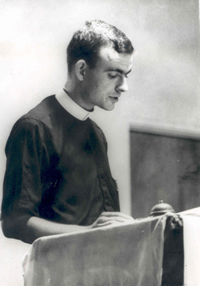
St. Jonathan Daniels

The news this week from Ferguson, Missouri, reminds us we still have a lot of healing and reconciliation to do in this country.  When I was on the Pine Ridge Reservation a few weeks ago, I experienced firsthand how events like the Wounded Knee Massacre still cast a long shadow on relationships between people of different races and ethnic backgrounds.

Today's saint, Jonathan Daniels, was a martyr during the Civil Rights movement of the 1960s - as I wrote about last year (http://benedictinelutheran.blogspot.com/2013/08/modern-martyrdom.html), he was a an Episcopal seminarian from New England who answered Martin Luther King Jr.'s call for assistance, and he ended up on the wrong end of a shotgun blast as a result. 


After spending time in Selma, Alabama in 1965, Daniels returned to seminary, and would have lived if he had stayed there.  But, he felt God was calling him to return:  “[S]omething had happened to me in Selma, which meant I had to come back. I could not stand by in benevolent dispassion any longer without compromising everything I know and love and value. The imperative was too clear, the stakes too high, my own identity was called too nakedly into question...I had been blinded by what I saw here (and elsewhere), and the road to Damascus led, for me, back here.”

Why was he called to go back to Alabama, a decision which cost him his life? He also wrote:  "I began to know in my bones and sinews that I had been truly baptized into the Lord’s death and resurrection...with them, the black men and white men, with all life, in him whose Name is above all names that the races and nations shout...we are indelibly and unspeakably one."

On Pine Ridge, I learned that the Lakota have a phrase for the kind of unity that Daniels spoke about: "Mitakuye Oyasin", or in English, "we are all related".  May God give us the strength to follow the example of St. Jonathan Daniels, so that we may continue the struggle for justice, peace, and reconciliation. 

If you are interested in learning more about Daniels, you can watch an excellent documentary about his life here:  http://vimeo.com/14117023

Wednesday, July 16, 2014

Religious Life and the Revival of the Church

I came across an excellent blog post today from an Episcopal priest (Fr. Robert Hendrickson) which says what I have been trying to say from the inception of this blog, albeit from a Lutheran perspective. Here are some of the key statements, relating to the renewal of the Church via a reinvigorated diaconate and neo-monastic movement:

First, he explains the issue and the goal: "[T]here are many, many people looking to have their faith be not something apart from the rest of their life or a distraction amidst a panoply of distractions. They are seeking a way for their faith to form their life and for their life to matter in the deepest ways possible.....  It seems to me that we might be entering a cultural moment in which we should consider the Religious life (monastic vocations) and the diaconate as the ideal means to form leaders equipped to engage the realities of contemporary society..... I firmly believe that intentional Religious Communities and a robust Diaconate are key to the rejuvenation of a vibrant Christian presence all across the country. The need is for missionary communities of prayer, service, and sacrificial giving."

Next, Fr. Hendrickson sets forth why a robust religious life is needed for the renewal of the Church: "This work begins with daily prayer and the Sacraments – but the churches that serve as the heart of this kind of disciplined approach to engaging the Holy would not be the final destination but the launching point for those trained and equipped to be the presence of Christ for those they meet and serve. I imagine local Churches serving as a sort of mother ship where people are fed and trained for missionary service...... These deacons would serve at the heart of local communities of those taking religious vows. Whether full-time, professed monastics or part of neo-monastic communities we should also be looking for those in our communities who are yearning for a deeper connection to other faithful people and are longing for their faith to ground their approach to work, relationship, and service. These kinds of communities could then become the heart of congregations longing for connection to the communities around them but fearful or unsure of taking the next step."

And then, he states his conclusion: "Ultimately, it will be these servant-leaders who are creatively making Christ known in the communities around us who will re-center the Church and draw others to come and see."

(The rest of the article can be read here -  http://thesubdeansstall.org/2014/07/16/the-diaconate-and-lay-religious-orders-the-shape-of-future-ministry/)

I agree 100% with Fr. Hendrickson's recommendations.  The perplexing thing for me, as a part of the ELCA, is that I am not quite sure how we can fit those recommendations into our existing paradigm for ministry.  As for the diaconate, our existing diaconal ministries are somewhat jumbled between three different lay orders (Diaconal Ministers, Associates in Ministry, and Deaconesses - I understand that there is a movement afoot to reform this, but I am not sure when this might take place, or what the result will be). But, at least we have an existing diaconal ministry which can be reformed and used to further the revival of the Church. 

As to the religious life, though, as I have long lamented, Lutherans have a long way to go.  Yes, there are some Lutheran religious communities around the world, which I have tried to promote (http://benedictinelutheran.blogspot.com/search/label/Lutheran%20Monastery%20Virtual%20Tour). There are also other movements which offer intriguing possibilities for the restoration of the religious life in American Lutheranism, such as the Order of Lutheran Franciscans (http://www.lutheranfranciscans.org/), but as of yet, these movements are not widely known among rank-and-file Lutherans. 

Those of us in Lutheranism who believe that a renewal of the religious life will be an important part of proclaiming the Gospel in a post-Christendom world are swimming against the tide of nearly 500 years of sentiment which is wary of (if not outright antagonistic to) the religious life.  Unlike Catholics, Orthodox, and Anglicans (at least since the 19th Century Oxford Movement), intentional communities of daily prayer are outside of the framework of reference of what institutional Lutheranism thinks "church" should look like. 

I am often reminded of how many Lutherans are unfamiliar with daily corporate prayer and the religious life when I am on Twitter, where I try to promote those things through my personal account (@PastorJayDenne) and through praying some of the daily offices via @Virtual_Abbey.  While some fellow Lutherans (both clergy and laity) follow and interact with those accounts, sometimes it seems as if I interact more with Catholics, Orthodox, and Anglicans than with Lutherans.  I saw a glaring example of this the other day, when I noticed that at the Virtual Abbey, Archbishop Kurtz (of the Archdiocese of Louisville, and the President of the United States Conference of Catholic Bishops) "retweeted" my morning prayers, but I have yet to see any Lutheran bishops follow or respond. (A caveat - my own Synod Bishop has been highly supportive, but I don't see him much on Twitter).

Does this mean that I am tilting at proverbial windmills a la Don Quixote?  Only time (and the Holy Spirit, of course) will tell.  But, I will keep trying, as I firmly believe in what Fr. Hendrickson said:

"We need passionate and powerful advocates for Christ in the communities around us – we need deacons and lay religious equipped for holy living. They can be, in our communities, the kinds of Christians that people never knew existed whose concern is not institutional maintenance or Church membership but is a faith lived so eloquently and authentically that their very being is evangelical.....They could be an inspiration for the congregation’s deepening sense of their own vocation as evangelists and servants." 

Monday, July 7, 2014

A Timeless Liturgy

Today, I'm going to take a break from my normal Monday musings on the sayings of ancient and modern Desert Fathers and Mothers, and write about an experience from yesterday that gave me joy. 


Over the July 4th weekend, we stayed at a hotel in Omaha, Nebraska, and just a few blocks away was Trinity Episcopal Cathedral, sitting among the downtown skyscrapers.


I noticed they offer a Rite I Eucharist on Sunday mornings at 8:30 a.m., so I decided to attend that service (one of the rare occasions when I am able to worship somewhere else on a Sunday morning).  For those of you who aren't familiar with Episcopal-ese, Rite I is the worship setting in the current Book of Common Prayer which maintains the "ye olde English" liturgy, complete with language such as this post-Communion prayer:

"Almighty and everliving God, we most heartily thank thee for that though dost feed us in these holy mysteries, with the spiritual food of the most precious Body and Blood of thy Son our Savior Jesus Christ; and dost assure us thereby of thy favor and goodness towards us; and that we are very members incorporate in the mystical body of thy Son, the blessed company of all faithful people; and are also heirs, through hope, of thy everlasting kingdom.  And we humbly beseech thee, O heavenly Father; so to assist us with thy grace, that we may continue in that holy fellowship, and do all such good works as thou hast prepared for us to walk in; through Jesus Christ our Lord, to whom, with thee and the Holy Ghost, be all honor and glory, world without end. Amen."

Use of that language is decidedly counter-cultural in 2014 - most churches these days stay as far away as possible from the type of language found in a Rite I Eucharist.  But, there is something about that language which reminds us that worship is a gathering of ordinary humans to experience something extraordinary.  Worship is not intended to be a gathering to learn about self-help methods, or listen to music with a religious sheen, but about an encounter with the divine "other" revealed to us as the Trinity - the Father, Son, and Holy Spirit. 


Since I would be attending a worship service at 8:30 a.m. on a holiday weekend, I was fearful that I would be the only one there to worship that morning.  Fortunately, I was wrong!  It was not a huge crowd, but there were several others of various ages (from young couples with small children on up) there that morning.

Why were they there at 8:30 a.m. on a Sunday morning during a holiday weekend?  Each worshiper would have their own unique reasons, of course.  But, regardless of their individual reasons, they came together as a community where there was a tangible presence of God, communicated to us through a timeless form of the liturgy, the hearing of the Word, and the reception of the Sacrament at the altar.   Those means of grace renew, strengthen, and nourish us, so that we can go out into the world with the following exhortation (spoken by the priest during each Rite I Eucharist service) in mind: 

"It is very meet, right, and our bounden duty, that we should at all times, and in all places, give thanks unto thee, O Lord, holy Father, almighty everlasting God."

Monday, May 19, 2014

The Desert in Modern Times? (Monday Morning in the Desert)

The lives of the ancient Desert Fathers and Mothers seems highly peculiar to 21st century people. A life defined by silence and prayer? Who has time for that?  Who would even want to do that?

Certainly, this kind of life is not for everyone.  God calls people to a variety of vocations in life, and for most of us, those vocations revolve around "regular" jobs or family life.  Contrary to modern reason, though, there are people who are called to live a life of silence and prayer now.  But, instead of living in the deserts of ancient Egypt, they live around us in houses or apartments, both in cities and in rural settings.

A modern day Desert Mother is Sister Verena Schiller, an Anglican who lives a solitary life in northern Wales.  She wrote a book about her life, and it contains this passage on why God has called some to solitary lives of prayer and silence in the midst of modernity:

"In our twentieth/twenty-first century western world, we no longer live in a society like that of early antiquity when almost all were believers of some sort and lived in a climate where faith in God or gods was almost universal.  To be a believing active Christian in our age was in itself becoming more rare.  And yet, and yet.... the thirst for things spiritual was very much in evidence, a thirst for a meaning to life beyond the excessive materialism and need for instant gratification so prevalent in our society at present. Many feel as though they are staring into an abyss.  Deep in the human psyche lies the longing for whatever we may mean by 'God' and many harbour a great fear that death might mean 'extinction'.  Deeper still lies this search for meaning.  For me it seemed that at least in part, the renewal of the eremitic life (life of a recluse in the desert tradition) in recent years was an aspect of this thirst. There was a sense of urgency that in a world that was changing so rapidly and seemingly intent on destroying itself, the times were urgent.  The counter-cultural intent of monasticism needed to regain its cutting edge.  So my move into solitude began to take shape."

(From p. 7 of "A Simplified Life" by Verena Schiller).


(An image from the area of rural Wales where Sister Verena lives, from an article about her located at: http://www.churchtimes.co.uk/articles/2010/15-october/faith/solitary,-but-not-unguided).


Some may ask: "But what do people like Sister Verena do, really? Aren't they just seeking an escape from the world?"  My response is that they are living more deeply in the world than those of us who supposedly live in the "real world" can possibly imagine.  While we are working, playing, eating, or sleeping, there are modern day Desert Fathers and Mothers praying for you, me, and the whole world. They take no breaks or vacations from prayer.  It defines who they are - they could no more give up prayer than you or I could give up breathing.

The Church, particularly in the Western world, is in the midst of a transition, and we are struggling to figure out our place within a society where belief in God is an afterthought at best. As a part of that transition, I believe the Church needs to identify and lift up those people, few as they may be, who have a calling to live a life defined by prayer.  Their prayers will lift up those of us who struggle, who hurt, or who do not know of God's presence in their daily lives.  So, as they pray for us, we should pray for those called to that life as well, that God may give them the strength to pray without ceasing for the Church, the world, and all of creation.

Saturday, April 26, 2014

A Mystical Renewal

One year ago this month, I started this blog, not knowing if anyone would read it.  While the number of people reading this blog isn't huge, I think there has been enough traffic to this site, and corresponding positive feedback, to verify something that I have suspected for awhile now: There is a desire among Lutherans, and members of similar traditions which arose at the time of the Reformation, to explore spiritual practices that have been minimized in our churches, even though they are a good and helpful part of our Catholic heritage.

In short, I will describe that desire as a hunger for mysticism.

Mysticism has become a dirty word in certain Protestant and Lutheran circles because there are uses of the word which are contrary to our beliefs, including some uses which are contrary to Christianity altogether. 

Mysticism can mean spiritual beliefs which blur the lines between the Creator and the created, and spiritual practices which lead to a belief that the best place to find God is by looking into yourself.  I'm not talking about that kind of mysticism.

Mysticism can also lead to a mindset which focuses on what we do for God, instead of what God has done for us.  I'm not talking about that kind of mysticism, either.

When I am talking about mysticism, I simply mean an awareness, through faith, of God's presence in our lives.  I believe that kind of mysticism is fully compatible with Christianity, as well as Lutheranism.  In fact, I would say that not only is that kind of mysticism compatible with our faith - it is necessary for our faith to be sustained.

The beliefs and practices I have written about on this blog have been related to that form of mysticism.  For example, the Jesus Prayer, lectio divina, and the daily rhythm of prayers and readings (found in the Rule of St. Benedict, and included in the lectionaries and daily prayer services in our Lutheran worship books as well as the Book of Common Prayer) help us to give thanks to God our Father, focus our attention on Christ and him crucified, and enhance our awareness of the presence of the Holy Spirit in and around us.

After all, Martin Luther himself had a profound mystical experience (commonly referred to as the "tower experience") after engaging in a period of meditation on Scripture, akin to lectio divina: 


“The words ‘righteous’ and ‘righteousness of God’ struck my conscience like lightning. When I heard them I was exceedingly terrified. If God is righteous [I thought], he must punish. But when by God’s grace I pondered, in the tower and heated room of this building, over the words, ‘He who through faith is righteous shall live’ [Rom. 1:17] and ‘the righteousness of God’ [Rom. 3:21], I soon came to the conclusion that if we, as righteous men, ought to live from faith and if the righteousness of God contribute to the salvation of all who believe, then salvation won’t be our merit but God’s mercy. My spirit was thereby cheered. For it’s by the righteousness of God that we’re justified and saved through Christ. These words [which had before terrified me] now became more pleasing to me. The Holy Spirit unveiled the Scriptures for me in this tower.”

(From Luther's Works Volume 54: Table Talk).


(The tower of the Augustinian monastery in Wittenberg where Luther was a monk).

So, thank you for accompanying me on my journey into blogging this past year.  With God's grace and help, I look forward to further exploration of the kind of Christian spiritual practices and beliefs which might help our awareness of God's presence in our lives. 

Tuesday, January 14, 2014

Lutheran Monastery Virtual Tour - A Return to Sweden

One of these days, I'll get back to my series on how the five senses relate to Christian spirituality (http://benedictinelutheran.blogspot.com/search/label/Five%20Senses%20of%20Spirituality).  In the meantime, I'm going to revisit the virtual tour of Lutheran monasteries that I embarked upon last summer (earlier entries can be found here: http://benedictinelutheran.blogspot.com/search/label/Lutheran%20Monastery%20Virtual%20Tour).

Why am I revisiting the tour now? I just found a list of several more Lutheran monasteries in this book: "Anglican Religious Life 2014-2015" - available here: http://www.amazon.com/Anglican-Religious-Life-2014-15-communities/dp/1848254644/ref=sr_1_1?ie=UTF8&qid=1389667060&sr=8-1&keywords=anglican+religious+life.  As you can guess from the title, 99% of the communities described in the book are found within the Anglican Communion, but there is a brief section in the book devoted to communities found in the Church of Sweden, which is linked to the Anglican Communion through the Porvoo Agreement. As I explained during my stop at the Ostanback Monastery in Sweden (http://benedictinelutheran.blogspot.com/2013/06/lutheran-monastery-virtual-tour-stop-3_22.html), the Church of Sweden retained more of the trappings of Catholicism when compared to most other Lutheran churches.  Therefore, the re-occurrence of several monastic communities in that country has been a natural outgrowth of their spiritual identity (or what remains of their spiritual identity, anyway).

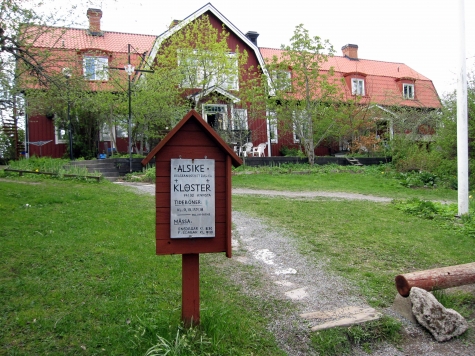
Sisters of the Holy Spirit

The Sisters of the Holy Spirit, located in Alsike, founded their community in 1965.  They pray the daily offices found in the Rule of St. Benedict, and are working with the Evangelical Lutheran Church of Kenya to expand there.  Their convent, which includes a retreat facility, is located in an old school house next to the parish church. The community also has a group of oblates and friends known as the "Friends of St. Nicholas."


You can read more about the history of their community at their website (part of which is in English):

http://alsikekloster.org/english/english1.htm

Sisters of Saint Francis

Another community in Sweden is the Sisters of Saint Francis, who have a convent north of Goteborg.  Following an adapted version of the Catholic Rule for the Third Order of Saint Francis, the Sisters pray four of the daily offices, and mass is celebrated three times each week.

If you can read Swedish, or are adept at using the Google translator, you can find out more about their community here:

http://www.klaradalskloster.se/

Other Communities

 The "Anglican Religious Life 2014-2015" book lists several other Swedish religious communities, but does not have any information about them other than an address and phone number.  They are:

Community of the Holy Trinity, located in Rattvik, Sweden
Mary Magdalene Sisters, located in Nacka, Sweden
Mary Daughters of the Evangelical Mariavagen, located in Enkoping, Sweden
Sankt Sigfrid Sisters, located in Ingelstad, Sweden
The Risen Saviour Sisterhood, located in Stallarholmen, Sweden

If anyone reading this blog knows anything about these communities (or any Lutheran monasteries I have missed on my virtual tour), please share what you know in the comments section, or contact me.

Friday, November 1, 2013

All Saints Day

Today, of course, is All Saints Day.  My favorite hymn about the saints is "Ye Watchers and Ye Holy Ones" and my congregation will be singing it on Sunday.  The hymn contains verses praising the angels, Mary, and the saints:

Ye watchers and ye holy ones,
Bright seraphs, cherubim and thrones,
Raise the glad strain, Alleluia!
Cry out, dominions, princedoms, powers,
Virtues, archangels, angels’ choirs:

(Refrain)
Alleluia! Alleluia!
Alleluia! Alleluia!
Alleluia!

O higher than the cherubim,
More glorious than the seraphim,
Lead their praises, Alleluia!
Thou bearer of th’eternal Word,
Most gracious, magnify the Lord.

(Refrain)

Respond, ye souls in endless rest,
Ye patriarchs and prophets blest,
Alleluia! Alleluia!
Ye holy twelve, ye martyrs strong,
All saints triumphant, raise the song.


(Refrain)

O friends, in gladness let us sing,
Supernal anthems echoing,
Alleluia! Alleluia!
To God the Father, God the Son,
And God the Spirit, Three in One.

(Refrain)

Here is a beautiful version of the hymn, sung by the choir of St. Anne's Cathedral (Anglican) in Belfast:


Monday, September 30, 2013

Modern Martyrdom in Pakistan

In America, typical sacrifices made to attend worship on Sunday morning relate to giving up our tee time at the golf course, changing the time we have set for brunch, or not in sleeping after a night out on the town.  

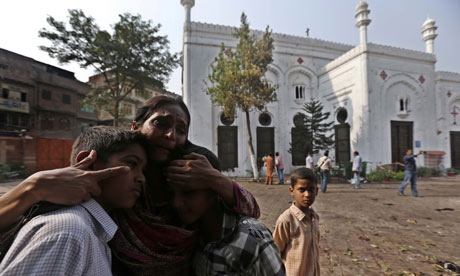
We have no clue what sacrifice really means, but the worshipers at All Saints Anglican Church in Peshawar, Pakistan do.  Over 80 of them were killed last week during a suicide bombing attack during worship.


O God, you make the blood of the martyrs the seed of the church: Grant that we who remember before you the blessed martyrs of Peshawar, who opened in the heart of Pakistan the loving way of your Son Jesus Christ, may like them, persevere unfalteringly in the faith for which they died, through the same Jesus Christ our Lord, who lives and reigns with you and the Holy Spirit, one God, forever and ever. Amen. 
 
(Adapted from the prayer about the Martyrs of Uganda found in "The New Book of Festivals and Commemorations" by Philip Pfatteicher).
 
UPDATE: Here is a link to a great article on Pakistan's Christian minority: http://www.pbs.org/newshour/rundown/2013/09/pakistan-christians-blog.html 
 
UPDATE #2: According to the Bishop of the Anglican Diocese of Peshawar, the death toll from the September 22nd bombing is 127, with 170 injured.  Here is a link which contains the Bishop's information, as well as links to sites which offer a way to help.

Tuesday, August 27, 2013

Lutheran Monastery Virtual Tour - The Final Stop(s)

The end of summer is rapidly approaching, and with it, the end of the summer travel season.  So, with that in mind, it is time for me to wrap up our little virtual tour of Lutheran monasteries. Instead of focusing on one monastery as I have done before, I'm going to take us to some of the ones we have missed thus far in our travels.

Amelungsborn Abbey - Germany

The Amelungsborn Abbey began as a Cistercian Monastery in the year 1135.  Following the Reformation, Duke Julius of Brunswick implemented the Reformation in his realm in the year 1568, and the abbot and community of Amelungsborn converted to Lutheranism. Andreas Steinhauer was the first Lutheran abbot, and he was the founder of the school for which the abbey is primarily known.


The abbey currently has an abbot and eight brothers, as well as approximately 30 members of a associated lay brotherhood. The following video contains beautiful music and imagery from the abbey - the narration is in German, but it is still enjoyable to watch:


For more information, there is a Wikipedia article in English:  http://en.wikipedia.org/wiki/Amelungsborn_Abbey

Their website (in German) is here:  http://www.kloster-amelungsborn.de/

Loccum Abbey - Germany

Loccum Abbey began as a Cisterician monastery in 1163 in the Lower Saxony region of Germany.  After the Reformation, the community became Lutheran, and today, the abbot is also the head of a seminary on the grounds of the monastery. 


For more information, a Wikipedia article in English can be found here:
http://en.wikipedia.org/wiki/Loccum_Abbey

Their website (in German) can be found here:
http://www.kloster-loccum.de/pages/index.html

Enonkoski Monastery - Finland

In Finland, there is one Lutheran monastery located in an old schoolhouse, currently inhabited by one permanent resident, Sister Virva Tyrväinen. The monastery is a place of quiet, rest, and prayer, offering people the opportunity to go on retreat, or for a short period of silence.  

Enonkoski monastery operates as an independent entity, but works with the Mikkeli diocesan bishop, and under the authority of and in cooperation with the Enonkoski chapel of the church.


 For more information, there is a short Wikipedia article:
http://en.wikipedia.org/wiki/The_Monastic_Protestant_Community_in_Enonkoski

They have a Facebook page:
https://www.facebook.com/enonkoskenluostariyhteiso

Also, they have a website (in Finnish):
http://www.luostariyhteiso.fi/

The Brothers of Saint John the Evangelist - United States

Technically, this monastery is a religious community of the Episcopal Church, but I am including it because: (a) some of the five men who founded the community in 1972 were Lutheran, and (b) since 2001, the Evangelical Lutheran Church in America and The Episcopal Church are in full communion with each other anyway.  The monastery is located in the State of Washington, where two of the founding members still live, and the monastery has an active group of oblates (lay members).


(An image of a Celtic cross on the grounds of the monastery)

The monastery follows the Rule of St. Benedict, and their stated goal is to:
“Advancing the Worship, Music and Arts of the Church.”

For more information, their website can be found here: http://brothersofsaintjohn.org

 
Conclusion
 
I hope you have enjoyed the virtual tour - I know I have learned a lot while researching these Lutheran monasteries.  Hopefully, their existence won't be such a secret in the Lutheran Church anymore!

Tuesday, August 20, 2013

Modern Martyrdom

"The blood of the martyrs is the seed of the Church" ~ Tertullian.

The images and stories coming from Egypt this week have reminded us that martyrs are not merely people from the distant past - people are being killed because of their faith in today's world.  At the same time the worldwide Church was honoring Mary on her feast day, St. Virgin Mary Coptic Orthodox Church (one of many churches in Egypt destroyed this week) was burning.  Here is an image of the remains of the Church's altar:


Martyrdom is not just something that happens "somewhere else" though.  One particular instance of modern martyrdom has captivated me since I first read the story a few years ago.  48 years ago today, on August 20, 1965, Jonathan Myrick Daniels was killed due to actions he took because of his Christian faith, right here in the United States.   

Daniels was a seminarian at the Episcopal Divinity School in Cambridge, Massachusetts in the spring of 1965, when Martin Luther King Jr. put out a call for students and clergy to come to Alabama and participate in a march from Selma to the state capital of Montgomery.  Daniels answered the call, and when he missed his bus to go back home, he stayed behind in Selma the rest of that semester to help the civil rights movement.  He returned to Cambridge for his final exams, and then went back to Alabama in July.


(An image of Daniels with two children in the house where he stayed in Alabama).

On August 14th, Daniels was arrested for protesting against a "whites only" store, and he was sent to a county jail in Haynesville, Alabama, along with several others.  After their release on August 20th, Daniels, along with a Catholic priest and two young African-Americans, went to a local store to get a soft drink.  They were met at the door by the store's owner, Tom Coleman, who was carrying a shotgun.  When Coleman aimed the gun at 17 year old Ruby Sales, Daniels pushed her away, and he caught the full impact of the blast in his chest, killing him instantly.

The story of his murder was reported nationally in the immediate aftermath of his death, and once again after his killer was acquitted by an all-white Alabama jury.

At his funeral, one of his professors read from a paper that Daniels wrote and submitted on June 22, 1965, entitled "Theological Reflections on My Experience in Selma."  Quoting the Magnificat (the song of Mary), Daniels wrote:

"All of this is the raw material for living theology.  And yet in as deep a sense, from my point of view, it is the product of living theology.  The doctrines of the creeds, the enacted faith of the sacraments, were the essential preconditions of the experience itself.  The faith with which I went to Selma has not changed: it has grown.  Darkening coals have kindled. Faith has taken wing and flown with a song in its wings. 'My soul doth magnify the Lord, and my Spirit hath rejoiced in God my Savior...'

I lost fear in the black belt (referring to a region in Alabama known for its dark soil) when I began to know in my bones and sinews that I had truly been baptized into the Lord's Death and Resurrection, that in the only sense that really matters I am already dead, and my life is hid with Christ in God."

(Quoted in the book "Outside Agitator" by Charles W. Eagles, p. 183).

Thursday, August 15, 2013

Mary and the Modern Church

In my denomination, the Evangelical Lutheran Church in America (ELCA), today is the day on the Church's calendar when we celebrate the life and witness of Mary, Mother of Our Lord.  In the Episcopal Church, today is known as the feast day of St. Mary the Virgin, Mother of Our Lord.  Catholic and Orthodox Christians celebrate Mary on several days each year, and today is known as the day they celebrate her assumption into heaven (Catholic) or dormition ("falling asleep" - Orthodox).


(Icon of the Dormition by Theophan the Greek, from the year 1392).

Late yesterday afternoon, on the eve of the day when the Church remembers Mary, our Churchwide Assembly elected a new Presiding Bishop, Elizabeth Eaton, who is the current Bishop of the Northeastern Ohio Synod.  I wasn't able to watch all of the election process online, but from what I did see, I suspect she gained a lot of support during the voting because of her candor in answering the questions posed to the nominees.  It was refreshing to hear someone acknowledge where we are as a denomination - wounded from battles that have raged about various matters since the merger that formed the ELCA 25 years ago, and the loss of almost 25% of its membership in those 25 years.

Also, judging from the various social media conversations about the election, once her candidacy gained some traction, a lot of the talk centered around the fact that her election would be historic - she would be the ELCA's first female Presiding Bishop.  Just a few years ago, the Episcopal Church elected its first female Presiding Bishop, Katherine Jefferts Schori.

I find it somewhat ironic that despite all of the talk about the leadership of women in the modern American denominations that descend from the Protestant Reformation, the leadership of Mary is still ignored by many. 

The typical Protestant reasoning for avoiding any discussion about Mary is the allegation that it takes the focus away from Jesus.  To the contrary, the life of Mary points to her Son.  For example, this reflection by a Benedictine monk (incorporating Eastern Orthodox theology) on the dormition shows how the role of Mary, properly understood, glorifies Christ:

"At Mary's death her Son appears like a heavenly midwife who has helped his mother give birth to herself into eternity.  Her newborn soul is represented as a child wrapped in swaddling clothes, a thought-provoking reversal of his own physical birth when she wrapped him in swaddling bands and laid him in the manger (Lk 2:7).  She gave birth to him into time: now he regenerates her into eternity.  It is Mary's personal pascha/transitus, her journey through death to life: but like that of all other believers it is accomplished not through her own strength but because of the paschal mystery of her Son."

(From p. 264 of "Meeting Christ in His Mysteries: A Benedictine Vision of the Spiritual Life" by Gregory Collins, OSB).

When she spoke to the assembly yesterday, Bishop Eaton talked about the importance of the theology of the cross. Who was at the foot of the cross, watching the crucifixion of her Son?  Mary.  John 19:26-27 tells us: "When Jesus saw his mother and the disciple whom he loved standing beside her, he said to his mother, 'Woman, here is your son.' Then he said to the disciple, 'Here is your mother.' And from that hour the disciple took her into his own home."

A theology of the cross that does not place us at the foot of the cross alongside Mary is no theology of the cross at all. 

Tuesday, July 9, 2013

The Origins of Lutheran Monks

Now that our family has returned from our vacation, described in my posts on Mountain Spirituality, I will soon resume the virtual tour of Lutheran monasteries.  In the meantime, I came across a brief historical note on a blog called "The Conciliar Anglican" about the origins of Lutheran monasticism.

The blog article is entitled "Ask an Anglican: What is Anglican Monasticism?" but it contains the following information about the history of Lutheran monks:

"[B]y the fifteenth century there were a large number of unofficial monastic movements. The most famous of these is the Devotio Moderna (literally ‘the Modern Devotion’, but also translatable as ‘the Modern-Day Devout’). The Devotio Moderna was primarily expressed in the Brethren of the Common Life. . . . 

For reasons that I know little about, the Roman Catholic church formally banned the Brethren of the Common Life at the Council of Trent. They lived on, however, in Lutheran lands until the nineteenth century. Martin Luther had a soft spot for them—no doubt because so much of their work consisted in educating the young, which Luther was a strong proponent of. Contrary to what is popularly assumed, the Lutherans did not formally ban monasticism; several Benedictine houses joined the Lutheran movement in the sixteenth century and still today there are Lutheran monasteries and convents. Although the Lutheran confessions were sharply critical of sixteenth-century monastic practice, they never formally rejected monasticism. I do not write this to argue that Lutheranism was somehow ‘more Catholic’ than later Protestant groups. Rather, I write this as a matter of fact: the Brethren of the Common Life were, together with the Lutheran Benedictines, part of the Lutheran tradition from pretty much the beginning."

The entire article can be read here: http://conciliaranglican.com/2013/07/08/ask-an-anglican-what-is-anglican-monasticism/

Monday, May 20, 2013

The Sacramental Quality of Reading Scripture

While the sacramental quality of Scripture had crossed my mind before, I don't think I had ever given much thought to what that effectively meant.  Two quotes I read today on another blog (http://curlewriver.wordpress.com/2013/05/20/the-calendar-and-the-bible-for-us-today/) brilliantly describe how the reading of Scripture is not mere devotional reading, but a real participation in the Biblical story.

The first is from Martin Thornton, quoting Sergius Bulgakov:
During the service of Christmas there is not merely the memory of the birth of Christ, but truly Christ is born in a mysterious manner, just as at Easter he is resurrected. … The life of the Church, in these services, makes actual for us the mystery of the Incarnation. … [I]t is given to the Church to make living these sacred memories so that we should be their new witnesses and participate in them. (Christian Proficiency, p.69)
The second is from Dietrich Bonhoeffer's classic book, "Life Together" - even though I've read through the book twice, the importance of this passage did not hit me until now:
Consecutive reading of biblical books forces everyone who wants to hear to put himself, or to allow himself to be found, where God has acted once and for all for the salvation of men. We become part of what once took place for our salvation. Forgetting and losing ourselves, we, too, pass through the Red Sea, through the desert, across the Jordan into the promised land. With Israel we fall into doubt and unbelief and through punishment and repentance experience again God’s help and faithfulness. All this is not mere reverie but holy, godly reality. We are torn out of our own existence and set down in the midst of the holy history of God on earth. There God dealt with us, and there he still deals with us, our needs and our sins, in judgment and grace. It is not that God is the spectator and sharer of our present life, howsoever important that is; but rather that we are the reverent listeners and participants in God’s action in the sacred story, the history of the Christ on earth. And only in so far as we are there, is God with us today also. (Life Together, p.38)

In the Lutheran tradition, we commonly refer to the pastoral office as the office of "Word and Sacrament." Given the sacramental quality of the Word, I'll have to rethink how I describe the office of ministry, as that phrase implies a dichotomy where there is none.  In any event, viewing the reading of Scripture as a sacramental action, where the reader is engaged in a real encounter with God, gives me a greater impetus to focus on the daily office of prayer and Scripture reading.


Tuesday, May 14, 2013

"Evangelical Catholic" Lutheranism?

As my blog title indicates, I prefer to think of myself as a "Benedictine Lutheran," but  I suppose that I arguably fit into the category of Lutheranism referred to as as "Evangelical Catholicism." I have seen that term used in a variety of ways over the years, and there have been entire threads on the American Lutheran Publicity Bureau forum devoted to the question of how to define an "Evangelical Catholic," but no consensus was reached as far as I could tell.

Generally speaking, I use the term to refer to Lutherans who maintain the emphasis on salvation by grace through faith (the "Evangelical" part), but in doing so, emphasize the importance of the liturgy, and do not view the Lutheran Confessions in a vacuum, but interpret them in light of the faith of the entire Church, particularly the Early Church Fathers (the "Catholic" part).  But, I admit that my somewhat vague definition is simply one among many.

Therefore, I have to admit I was somewhat jealous when I saw this concise explanation of what it means to be a "Catholic" from an Anglican perspective, as demonstrated in a slideshow devoted to the spirituality of the Book of Common Prayer:  

http://akensidepress.com/blog/2013/05/the-liturgical-spirituality-of-the-prayer-book-an-intro/

So, this slideshow made me wonder if such a concise slideshow could ever be made about what it means to be a "Catholic" from an Evangelical Lutheran perspective.  Or are we too fractured into varying groups who express their "Evangelical Catholicism" in disparate ways, such as a strict view of the Confessions, or taking an ultra "high church" view of the liturgy? 

Certainly, many Lutheran theologians (Arthur Carl Piepkorn, Bishop Bo Giertz, Carl Braaten, and Robert W. Jenson to name a few) have written a great deal on the intended catholicity of the Lutheran movement.  But, for me at least, the question of how to describe an "Evangelical Catholic" Lutheran remains unanswered.  One of the reasons I started this blog was that I viewed it as a forum to air my thoughts and invite discussion on this subject, so there will be more on this subject to come.      


Monday, May 6, 2013

The Benedictine Parish


A few weeks ago, I saw a reference online to a book called “The Benedictine Parish: A Model to Thrive in a Secular Era,” so I ordered it from the publisher.  I’ve read various books on Benedictine spirituality, but the title intrigued me because it promised something unique – it was not another volume devoted to the application of Benedictine spirituality to an individual or a monastic setting, but instead, to a parish. 

What did I think of it? This little (29 pages) booklet contained exactly what I have been looking for – an example of how to apply the Benedictine ethos in parish life.

The contents of the book are presented in question and answer format, with parishioner Matthew Dallman posing questions to the longtime priest of St. Paul’s Episcopal Church of Riverside Illinois, Father Thomas Fraser.   The result is that the book is engaging and full of anecdotes about how the Benedictine model was introduced into the parish, and the results from its gradual implementation over a period of thirty years.

St. Paul’s was a dying parish in suburban Chicago when Father Fraser proposed that they get radical and go “back to the roots.” What was causing the parish to die? Like many other congregations, it was desperately trying to hold on to the 1950’s model for churches – the conventional, program based model.   A conventional, program based model worked during Christendom, when the overwhelming majority of people desired to go to church.  Parishes could serve as clinics, offering religious goods and services to parishioners as needed.

But, with the end of Christendom rapidly approaching, that model was no longer working, so it was either time to die gracefully or do something radical.  Father Fraser and St. Paul’s parish chose to do the latter.

What does the Benedictine model involve?  It involves the gradual introduction of praying the daily office among not only clergy, but among the core of the parish.  The liturgy does not revolve around ceremony and performances, but common prayer and chant.  Programs are not offered for the sake of occupying people’s time and entertaining them, but are specifically designed for spiritual formation and preparation for ministry.

Regarding preparation for ministry, the laity are integrally involved in the ministries of a Benedictine parish.  The laity are not consumers of religious goods and services, but are trained and committed to the life and mission of the parish.  The role of the clergy is to serve as an Abbot does in a monastic setting – not as a crisis clinician brought in to solve problems as needed, but someone who has an ongoing relationship with each member of the community.

The book is specifically aimed at parishes in the Episcopal/Anglican tradition, but Lutheran congregations could benefit from the wisdom of the Benedictine model.   In recent years, there has been a resurgence in praying the daily office in Lutheran circles (as evidenced by the publication of prayer books such as “For All the Saints” from the ALPB and “The Daily Prayer of the Church” by Phillip Pfatteicher) so for many congregations, parts of the Benedictine model are already in place. 

For more information, check out the Akenside Press website: 

http://akensidepress.com/