I was planning on breaking my blogging silence with a reflection and summary of my time spent at the conference of the International Thomas Merton Society a couple of weeks ago (which included a day trip to the Abbey of Gethsemani). I'm still planning on doing that, but in light of this week's events, that seems unimportant right now.
I have nothing to add to the many fine reflections offered these past few days, either regarding the tragic nature of the death of nine people at Emanuel AME in Charleston, or the racism that motivated their killing. This one hits particularly close to home since the shooter was a member of an ELCA congregation, and two of those killed graduated from the ELCA seminary in South Carolina, and I have friends who knew them.
So, I have no words of my own to add. I would simply note that during times like these, the focus on the Psalms within Benedictine spirituality has given me these words (from Psalm 13) to ponder when I think about the state of our country:
How long, O Lord? Will you forget me forever? How long will you hide your face from me?
How long must I bear pain in my soul, and have sorrow in my heart all day long?
How long shall my enemy be exalted over me? Consider and answer me, O Lord my God! Give light to my eyes, or I will sleep the sleep of death, and my enemy will say, “I have prevailed”; my foes will rejoice because I am shaken.
But I trusted in your steadfast love; my heart shall rejoice in your salvation.
I will sing to the Lord, because he has dealt bountifully with me.
Showing posts with label Modern Martyrdom. Show all posts
Showing posts with label Modern Martyrdom. Show all posts
Saturday, June 20, 2015

Friday, April 3, 2015
The Living Reality of the Cross
I did not intend to take a break from blogging during Lent, but that is what ended up happening. After Easter, I will be spending more time at Sacred Heart Monastery in Yankton, where I am being trained to become a spiritual director. After that, hopefully I will be able to resume blogging on at least a semi-regular basis.
In the meantime, on this Good Friday, it occurs to me how the cross was not a one-time event, buried deep within human history. When 21 Coptic Christians were beheaded this year, the cross was a living reality. When 147 people were massacred at a college in Kenya this week, the cross was a living reality. When millions were being exterminated in the 20th century in Germany, Eastern Europe, and Russia, the cross was a living reality.
Perhaps the most profound statement about the living reality of the cross was not from a Christian theologian, but from a Jewish boy who survived the Nazi holocaust. In his book, Night, Elie Wiesel recounted the following occurrence from his childhood experience in a concentration camp:
Behind me, I heard the same man asking:
“For God’s sake, where is God?”
And from within me, I heard a voice answer:
“Where is He? This is where – hanging here from this gallows…”
In the meantime, on this Good Friday, it occurs to me how the cross was not a one-time event, buried deep within human history. When 21 Coptic Christians were beheaded this year, the cross was a living reality. When 147 people were massacred at a college in Kenya this week, the cross was a living reality. When millions were being exterminated in the 20th century in Germany, Eastern Europe, and Russia, the cross was a living reality.
Perhaps the most profound statement about the living reality of the cross was not from a Christian theologian, but from a Jewish boy who survived the Nazi holocaust. In his book, Night, Elie Wiesel recounted the following occurrence from his childhood experience in a concentration camp:
Behind me, I heard the same man asking:
“For God’s sake, where is God?”
And from within me, I heard a voice answer:
“Where is He? This is where – hanging here from this gallows…”
Monday, September 8, 2014
Death and Life (Monday Morning in the Desert)
Words from a recent sermon by Victoria Osteen, the wife of famous preacher Joel Osteen, have circled around the internet the past few weeks, and have been picked apart by numerous other bloggers and commentators, so I apologize for jumping on that bandwagon. (If you missed that story, the essence of her message was that we are to "do good for our own self" and not for God, because God just wants us to "be happy" https://www.youtube.com/watch?v=koIBkYl0cHk).
In a world where Christianity has all but been eradicated in Iraq, where ancient Christian communities have worshiped for nearly 2,000 years, and where journalists trying to cover events in that region are being captured and beheaded, those types of messages emanating from American Christianity must seem quite peculiar to the rest of the world, to say the least. In the spirit of Martin Luther's commentary on the Eighth Commandment (the one about bearing false witness against our neighbor, according to the Lutheran/Catholic numbering of the Ten Commandments), I won't say more, except to just offer this quote from an anonymous Carthusian monk:
"Death to self and life in God are inseparably linked: the one without the other remains sterile." (From p. 43 of "The Prayer of Love and Silence".
In a world where Christianity has all but been eradicated in Iraq, where ancient Christian communities have worshiped for nearly 2,000 years, and where journalists trying to cover events in that region are being captured and beheaded, those types of messages emanating from American Christianity must seem quite peculiar to the rest of the world, to say the least. In the spirit of Martin Luther's commentary on the Eighth Commandment (the one about bearing false witness against our neighbor, according to the Lutheran/Catholic numbering of the Ten Commandments), I won't say more, except to just offer this quote from an anonymous Carthusian monk:
"Death to self and life in God are inseparably linked: the one without the other remains sterile." (From p. 43 of "The Prayer of Love and Silence".
Thursday, August 14, 2014
St. Jonathan Daniels
The news this week from Ferguson, Missouri, reminds us we still have a lot of healing and reconciliation to do in this country. When I was on the Pine Ridge Reservation a few weeks ago, I experienced firsthand how events like the Wounded Knee Massacre still cast a long shadow on relationships between people of different races and ethnic backgrounds.
Today's saint, Jonathan Daniels, was a martyr during the Civil Rights movement of the 1960s - as I wrote about last year (http://benedictinelutheran.blogspot.com/2013/08/modern-martyrdom.html), he was a an Episcopal seminarian from New England who answered Martin Luther King Jr.'s call for assistance, and he ended up on the wrong end of a shotgun blast as a result.
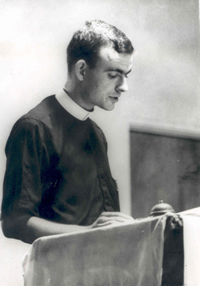
After spending time in Selma, Alabama in 1965, Daniels returned to seminary, and would have lived if he had stayed there. But, he felt God was calling him to return: “[S]omething had happened to me in Selma, which meant I had to come back. I could not stand by in benevolent dispassion any longer without compromising everything I know and love and value. The imperative was too clear, the stakes too high, my own identity was called too nakedly into question...I had been blinded by what I saw here (and elsewhere), and the road to Damascus led, for me, back here.”
Why was he called to go back to Alabama, a decision which cost him his life? He also wrote: "I began to know in my bones and sinews that I had been truly baptized into the Lord’s death and resurrection...with them, the black men and white men, with all life, in him whose Name is above all names that the races and nations shout...we are indelibly and unspeakably one."
On Pine Ridge, I learned that the Lakota have a phrase for the kind of unity that Daniels spoke about: "Mitakuye Oyasin", or in English, "we are all related". May God give us the strength to follow the example of St. Jonathan Daniels, so that we may continue the struggle for justice, peace, and reconciliation.
If you are interested in learning more about Daniels, you can watch an excellent documentary about his life here: http://vimeo.com/14117023
Today's saint, Jonathan Daniels, was a martyr during the Civil Rights movement of the 1960s - as I wrote about last year (http://benedictinelutheran.blogspot.com/2013/08/modern-martyrdom.html), he was a an Episcopal seminarian from New England who answered Martin Luther King Jr.'s call for assistance, and he ended up on the wrong end of a shotgun blast as a result.
After spending time in Selma, Alabama in 1965, Daniels returned to seminary, and would have lived if he had stayed there. But, he felt God was calling him to return: “[S]omething had happened to me in Selma, which meant I had to come back. I could not stand by in benevolent dispassion any longer without compromising everything I know and love and value. The imperative was too clear, the stakes too high, my own identity was called too nakedly into question...I had been blinded by what I saw here (and elsewhere), and the road to Damascus led, for me, back here.”
Why was he called to go back to Alabama, a decision which cost him his life? He also wrote: "I began to know in my bones and sinews that I had been truly baptized into the Lord’s death and resurrection...with them, the black men and white men, with all life, in him whose Name is above all names that the races and nations shout...we are indelibly and unspeakably one."
On Pine Ridge, I learned that the Lakota have a phrase for the kind of unity that Daniels spoke about: "Mitakuye Oyasin", or in English, "we are all related". May God give us the strength to follow the example of St. Jonathan Daniels, so that we may continue the struggle for justice, peace, and reconciliation.
If you are interested in learning more about Daniels, you can watch an excellent documentary about his life here: http://vimeo.com/14117023
Wednesday, April 9, 2014
A New Advertising Campaign for the Church
Church advertising campaigns often contain catchy or cute slogans, combined with pictures of smiling families.
Maybe instead of smiling families, the next picture that churches should use in a campaign to attract new worshipers should look something like this:

The person at the center of the picture is St. Benjamin of Petrograd. He was consecrated a bishop in the Russian Orthodox Church in 1910, only a few years before the Russian Revolution. When the communists took over and formed what would become known as the Soviet Union, Russian clergy became prime targets of persecution - in the coming years, nearly all of them were either executed or sent to forced labor camps.
St. Benjamin was arrested in 1922 because of his status as a bishop, and the picture is from his trial. The beliefs of the common people remained strong, and as he entered the courtroom for his trial, people stood up for him while he blessed them. When offered a chance to speak, he told the court that it saddened him to be called an enemy of the people, when he had always loved the people because of his love for God. Nevertheless, he was found guilty and condemned to death. In August, 1922, he was taken out to the firing squad, dressed in rags and clean-shaven, so that those carrying out the execution would not know he was a member of the clergy.
Also, today, April 9, is the 69th anniversary of the death of Dietrich Bonhoeffer, so today is the day that we remember him in the Lutheran church. Bonhoeffer, of course, was the German Lutheran pastor who was executed by the Nazis in the closing days of World War II. A slogan that could accompany the picture in this new marketing campaign would use Bonhoeffer's words: "When Christ calls a man, he bids him come and die."
A congregation using this picture and slogan would probably not attract casual worshipers who are looking for a place to make them happy and satisfied. But, the marketing campaign would perhaps send a message - a message that the Church exists to welcome people into the Body of Christ, and to nourish their faith through Word and Sacrament. What kind of faith? A kind of faith that does not expect God to shower us with happiness and contentment, but a faith in God that can survive the trials and ordeals of our lives. A kind of faith that can even be sustained under extreme circumstances, like the circumstances dealt to St. Benjamin and Dietrich Bonhoeffer. A kind of faith, given and strengthened by the Holy Spirit, that allows a person to stand in front of the face of evil and proclaim the Gospel.
Maybe instead of smiling families, the next picture that churches should use in a campaign to attract new worshipers should look something like this:
The person at the center of the picture is St. Benjamin of Petrograd. He was consecrated a bishop in the Russian Orthodox Church in 1910, only a few years before the Russian Revolution. When the communists took over and formed what would become known as the Soviet Union, Russian clergy became prime targets of persecution - in the coming years, nearly all of them were either executed or sent to forced labor camps.
St. Benjamin was arrested in 1922 because of his status as a bishop, and the picture is from his trial. The beliefs of the common people remained strong, and as he entered the courtroom for his trial, people stood up for him while he blessed them. When offered a chance to speak, he told the court that it saddened him to be called an enemy of the people, when he had always loved the people because of his love for God. Nevertheless, he was found guilty and condemned to death. In August, 1922, he was taken out to the firing squad, dressed in rags and clean-shaven, so that those carrying out the execution would not know he was a member of the clergy.
Also, today, April 9, is the 69th anniversary of the death of Dietrich Bonhoeffer, so today is the day that we remember him in the Lutheran church. Bonhoeffer, of course, was the German Lutheran pastor who was executed by the Nazis in the closing days of World War II. A slogan that could accompany the picture in this new marketing campaign would use Bonhoeffer's words: "When Christ calls a man, he bids him come and die."
A congregation using this picture and slogan would probably not attract casual worshipers who are looking for a place to make them happy and satisfied. But, the marketing campaign would perhaps send a message - a message that the Church exists to welcome people into the Body of Christ, and to nourish their faith through Word and Sacrament. What kind of faith? A kind of faith that does not expect God to shower us with happiness and contentment, but a faith in God that can survive the trials and ordeals of our lives. A kind of faith that can even be sustained under extreme circumstances, like the circumstances dealt to St. Benjamin and Dietrich Bonhoeffer. A kind of faith, given and strengthened by the Holy Spirit, that allows a person to stand in front of the face of evil and proclaim the Gospel.
Friday, February 21, 2014
Les Miserables in Real Life in Ukraine
As the old saying goes, history repeats itself.
Last fall, I had the opportunity to be involved with a stage production of the musical, Les Miserables. The musical, based on the classic novel, is a fictional account of a real-life event - an uprising by students against the French regime in the 1800s. What is going on in Ukraine right now is a real-life version of the events depicted in Les Miserables, including the barricades:

Ukraine even has its own version of Eponine- the young woman from Les Miserables who was shot and killed at the barricade. Olesya Zhukovskaya is a 21 year old medic who was tending to the wounded and dying in the streets when she was shot in the neck by a sniper. After being shot, she posted the words "I'm dying" on a social media website. Fortunately, so far, she has avoided Eponine's fate and survived following emergency surgery.

Meanwhile, the witness of the clergy in Ukraine continues to amaze me. Here is an incredible image of a Greek Catholic priest, with a riot shield in one hand, a cross in the other, and a gas mask around his neck.

More amazing images of clergy on the front lines in Ukraine can be found here:
Please continue praying for peace in Ukraine.
Wednesday, February 19, 2014
A Lutheran Presence in Ukraine
Previously, I shared my thoughts on the presence of priests and monks, acting as witnesses for peace in the midst of strife in Ukraine. (See http://benedictinelutheran.blogspot.com/2014/01/a-monastic-witness-for-peace-in-ukraine.html and http://benedictinelutheran.blogspot.com/2014/01/fear-monday-morning-in-desert-series.html). In the latest round of violence, which is proving to be even bloodier than what happened last month, Lutheran clergy are also acting as peacemakers.
This is Andreas Hamburg, Pastor of the Lutheran Church in Odessa, Ukraine. He was assaulted this morning by Titushky (pro-Government hooligans) while trying to protect demonstrators, and was saved by a police officer, who he calls his guardian angel. He asks for prayers for the people of Ukraine.

(From this Facebook page: https://www.facebook.com/photo.php?fbid=623095377743546&set=a.267575909962163.80352.100001292685359&type=1&theater)
May the Lord have mercy on the people of Ukraine, and may peace come soon.
This is Andreas Hamburg, Pastor of the Lutheran Church in Odessa, Ukraine. He was assaulted this morning by Titushky (pro-Government hooligans) while trying to protect demonstrators, and was saved by a police officer, who he calls his guardian angel. He asks for prayers for the people of Ukraine.
(From this Facebook page: https://www.facebook.com/photo.php?fbid=623095377743546&set=a.267575909962163.80352.100001292685359&type=1&theater)
May the Lord have mercy on the people of Ukraine, and may peace come soon.
Monday, January 27, 2014
Fear (Monday Morning in the Desert Series)
Since my last post, images of monks and priests praying in the middle of the unrest in Ukraine have circulated around the internet and captivated the world. So, I've been wondering to myself: Would I have the courage to do what they have done?
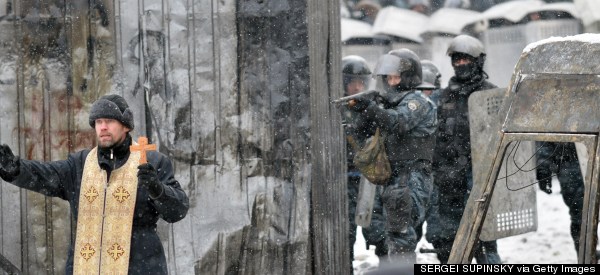
I don't know if I would have had the guts to stand in front of protestors with armed police pointing guns at my back. The only way I could stand there would be due to the result of prayer for strength, despite my fear. This anecdote from the Desert Fathers reminds us of the power of prayer, even during times of intense fear:
"A brother asked Theodore, 'If you suddenly hear the sound of falling masonry, are you frightened, abba?' He said, 'If the heavens fell down on the earth, Theodore would not be afraid.' For he had prayed to God that fear might be taken from him."
(From p. 61 of "The Desert Fathers: Sayings of the Early Christian Monks", translated by Benedicta Ward).
I don't know if I would have had the guts to stand in front of protestors with armed police pointing guns at my back. The only way I could stand there would be due to the result of prayer for strength, despite my fear. This anecdote from the Desert Fathers reminds us of the power of prayer, even during times of intense fear:
"A brother asked Theodore, 'If you suddenly hear the sound of falling masonry, are you frightened, abba?' He said, 'If the heavens fell down on the earth, Theodore would not be afraid.' For he had prayed to God that fear might be taken from him."
(From p. 61 of "The Desert Fathers: Sayings of the Early Christian Monks", translated by Benedicta Ward).
Thursday, January 23, 2014
A Monastic Witness for Peace in the Ukraine
A common criticism of monasticism is based on the assumption that monks want to get away from the world, and not be a witness in the world. While this criticism might be fairly applied to some, throughout almost the entire history of Christianity, monks have been witnesses to the world around them. This week, a picture of three monks from the Ukraine reminds us of the powerful witness that monks can provide to the world around them.
Although these events are not getting widespread coverage in American media, there is a significant amount of unrest in Ukraine right now. During anti-government protests, several have been killed, and hundreds injured.
In the midst of the unrest, these monks made a stand for peace:

A source from Ukraine wrote about the story behind the picture:
"[Wednesday] morning, monks from the Kiev-Caves Lavra Fr. Gabriel, Fr. Melchisedek, and Fr. Ephraim stood on Grushevsky Street in Kiev with a cross and icons, between the demonstrators and the Ukrainian special police force 'Berkut', and stopped the conflict. They entered the arena as peace-makers, and not in support of one side or the other.
Although they were invited to join the 'people', the fathers only prayed and sang the Paschal troparion: 'Christ is risen from the dead, trampling down death by death, and upon those in the tombs bestowing life,' wrote the Ramensky deanery of Moscow on its facebook page. The conflict ceased."
From http://www.patheos.com/blogs/billykangas/2014/01/monks-from-the-kiev-caves-lavra-stand-between-police-and-demonstrators-in-kiev-orthochristian-com.html
UPDATE: Here is a link to am amazing set of pictures of priests and monks who have put their lives on the line by putting themselves in the middle of the conflict to pray: http://www.huffingtonpost.com/2014/01/24/kiev-protests-priests_n_4660431.html
Although these events are not getting widespread coverage in American media, there is a significant amount of unrest in Ukraine right now. During anti-government protests, several have been killed, and hundreds injured.
In the midst of the unrest, these monks made a stand for peace:
A source from Ukraine wrote about the story behind the picture:
"[Wednesday] morning, monks from the Kiev-Caves Lavra Fr. Gabriel, Fr. Melchisedek, and Fr. Ephraim stood on Grushevsky Street in Kiev with a cross and icons, between the demonstrators and the Ukrainian special police force 'Berkut', and stopped the conflict. They entered the arena as peace-makers, and not in support of one side or the other.
Although they were invited to join the 'people', the fathers only prayed and sang the Paschal troparion: 'Christ is risen from the dead, trampling down death by death, and upon those in the tombs bestowing life,' wrote the Ramensky deanery of Moscow on its facebook page. The conflict ceased."
From http://www.patheos.com/blogs/billykangas/2014/01/monks-from-the-kiev-caves-lavra-stand-between-police-and-demonstrators-in-kiev-orthochristian-com.html
UPDATE: Here is a link to am amazing set of pictures of priests and monks who have put their lives on the line by putting themselves in the middle of the conflict to pray: http://www.huffingtonpost.com/2014/01/24/kiev-protests-priests_n_4660431.html
Friday, January 17, 2014
St. Anthony and the Modern Christian Predicament
Today is the day the Church commemorates St. Anthony, who was a Desert Father, and generally regarded to be the founder of what became the monastic movement in Christianity. He lived from approximately 251-356 A.D., so during his long life, he experienced persecution by the Roman Empire, as well as the legalization of Christianity under Emperor Constantine.
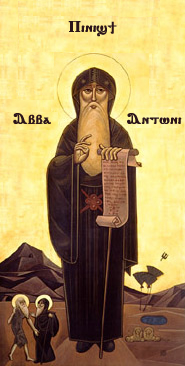
These days, Christians spend a lot of time on social media talking about two aspects of the modern Christian predicament: (1) The growing atheist movement in the West, and in particular, the attack on faith by writers such as Christopher Hitchens and Richard Dawkins, and (2) The growing persecution of Christians in the East, which I have written about on prior occasions: http://benedictinelutheran.blogspot.com/search/label/Modern%20Martyrdom).
These words from St. Anthony (which, at times, sound a lot like something Luther would write) remind us that our predicament is not new, as he wrote these words in response to the pagan philosophers who were challenging Christianity:
"We Christians, therefore, do not possess the mystery through the wisdom of Greek words but through the power of faith supplied to us by God through Jesus Christ. And so you will know that what I am saying is true, look now: although we do not know how to write, we believe in God, recognizing through his words his universal providence. And that our faith works, look now: we depend on our faith in Christ while you wage war with sophistries; and while your idols and delusionary practices have got you nowhere, our faith is spreading everywhere.
You people, with all your syllogisms and sophistries, are not persuading us to convert form Christianity to paganism: we, on the other hand, teaching faith in Christ, are stripping you of your superstitions, with everyone recognizing that Christ is God and the Son of God. You, with all your fine and fancy words, do not hinder the teaching of Christ: we, on the other hand, invoking the name of Christ crucified, are putting to flight all the demons, whom you fear as Gods. Wherever one sees the sign of the cross, magic loses its power and sorcery has no effect.....
[Y]our beliefs have never been persecuted, and yet our religion blossoms and flourishes more than yours. What is more, your religion, celebrated and protected on all sides, is falling into ruin, whereas the faith and teaching of Christ, ridiculed by you and often persecuted by emperors, has filled the whole world!...
These signs suffice to demonstrate that faith in Christ is the only worship of God. But if still you do not believe, seeking logical proofs through words, we will not offer proof by means of "plausible Greek wisdom", as our teacher said (1 Corinthians 2:4), but will persuade by means of the faith that is clearly outpacing your wordy fabrications."
(Quoted at pp. 60-61 of "The Desert Fathers: Saint Anthony and the Beginnings of Monasticism" by Peter H. Gorg).
St. Anthony reminds us that the mysteries of God are infinitely greater than what our human minds can grasp, and that God's glory transcends our human suffering. So, even though we lament the modern Christian predicament, if we pay attention to the witness of the saints who have gone before us, there is hope.
These days, Christians spend a lot of time on social media talking about two aspects of the modern Christian predicament: (1) The growing atheist movement in the West, and in particular, the attack on faith by writers such as Christopher Hitchens and Richard Dawkins, and (2) The growing persecution of Christians in the East, which I have written about on prior occasions: http://benedictinelutheran.blogspot.com/search/label/Modern%20Martyrdom).
These words from St. Anthony (which, at times, sound a lot like something Luther would write) remind us that our predicament is not new, as he wrote these words in response to the pagan philosophers who were challenging Christianity:
"We Christians, therefore, do not possess the mystery through the wisdom of Greek words but through the power of faith supplied to us by God through Jesus Christ. And so you will know that what I am saying is true, look now: although we do not know how to write, we believe in God, recognizing through his words his universal providence. And that our faith works, look now: we depend on our faith in Christ while you wage war with sophistries; and while your idols and delusionary practices have got you nowhere, our faith is spreading everywhere.
You people, with all your syllogisms and sophistries, are not persuading us to convert form Christianity to paganism: we, on the other hand, teaching faith in Christ, are stripping you of your superstitions, with everyone recognizing that Christ is God and the Son of God. You, with all your fine and fancy words, do not hinder the teaching of Christ: we, on the other hand, invoking the name of Christ crucified, are putting to flight all the demons, whom you fear as Gods. Wherever one sees the sign of the cross, magic loses its power and sorcery has no effect.....
[Y]our beliefs have never been persecuted, and yet our religion blossoms and flourishes more than yours. What is more, your religion, celebrated and protected on all sides, is falling into ruin, whereas the faith and teaching of Christ, ridiculed by you and often persecuted by emperors, has filled the whole world!...
These signs suffice to demonstrate that faith in Christ is the only worship of God. But if still you do not believe, seeking logical proofs through words, we will not offer proof by means of "plausible Greek wisdom", as our teacher said (1 Corinthians 2:4), but will persuade by means of the faith that is clearly outpacing your wordy fabrications."
(Quoted at pp. 60-61 of "The Desert Fathers: Saint Anthony and the Beginnings of Monasticism" by Peter H. Gorg).
St. Anthony reminds us that the mysteries of God are infinitely greater than what our human minds can grasp, and that God's glory transcends our human suffering. So, even though we lament the modern Christian predicament, if we pay attention to the witness of the saints who have gone before us, there is hope.
Monday, September 30, 2013
Modern Martyrdom in Pakistan
In America, typical sacrifices made to attend worship on Sunday morning relate to giving up our tee time at the golf course, changing the time we have set for brunch, or not in sleeping after a night out on the town.
We have no clue what sacrifice really means, but the worshipers at All Saints Anglican Church in Peshawar, Pakistan do. Over 80 of them were killed last week during a suicide bombing attack during worship.
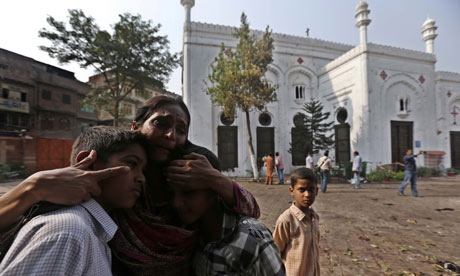
We have no clue what sacrifice really means, but the worshipers at All Saints Anglican Church in Peshawar, Pakistan do. Over 80 of them were killed last week during a suicide bombing attack during worship.
O God, you make the blood of the martyrs the seed of the church: Grant that we who remember before you the blessed martyrs of Peshawar, who opened in the heart of Pakistan the loving way of your Son Jesus Christ, may like them, persevere unfalteringly in the faith for which they died, through the same Jesus Christ our Lord, who lives and reigns with you and the Holy Spirit, one God, forever and ever. Amen.
(Adapted from the prayer about the Martyrs of Uganda found in "The New Book of Festivals and Commemorations" by Philip Pfatteicher).
UPDATE: Here is a link to a great article on Pakistan's Christian minority: http://www.pbs.org/newshour/rundown/2013/09/pakistan-christians-blog.html
UPDATE #2: According to the Bishop of the Anglican Diocese of Peshawar, the death toll from the September 22nd bombing is 127, with 170 injured. Here is a link which contains the Bishop's information, as well as links to sites which offer a way to help.
Tuesday, August 20, 2013
Modern Martyrdom
"The blood of the martyrs is the seed of the Church" ~ Tertullian.
The images and stories coming from Egypt this week have reminded us that martyrs are not merely people from the distant past - people are being killed because of their faith in today's world. At the same time the worldwide Church was honoring Mary on her feast day, St. Virgin Mary Coptic Orthodox Church (one of many churches in Egypt destroyed this week) was burning. Here is an image of the remains of the Church's altar:

Martyrdom is not just something that happens "somewhere else" though. One particular instance of modern martyrdom has captivated me since I first read the story a few years ago. 48 years ago today, on August 20, 1965, Jonathan Myrick Daniels was killed due to actions he took because of his Christian faith, right here in the United States.
Daniels was a seminarian at the Episcopal Divinity School in Cambridge, Massachusetts in the spring of 1965, when Martin Luther King Jr. put out a call for students and clergy to come to Alabama and participate in a march from Selma to the state capital of Montgomery. Daniels answered the call, and when he missed his bus to go back home, he stayed behind in Selma the rest of that semester to help the civil rights movement. He returned to Cambridge for his final exams, and then went back to Alabama in July.

(An image of Daniels with two children in the house where he stayed in Alabama).
On August 14th, Daniels was arrested for protesting against a "whites only" store, and he was sent to a county jail in Haynesville, Alabama, along with several others. After their release on August 20th, Daniels, along with a Catholic priest and two young African-Americans, went to a local store to get a soft drink. They were met at the door by the store's owner, Tom Coleman, who was carrying a shotgun. When Coleman aimed the gun at 17 year old Ruby Sales, Daniels pushed her away, and he caught the full impact of the blast in his chest, killing him instantly.
The story of his murder was reported nationally in the immediate aftermath of his death, and once again after his killer was acquitted by an all-white Alabama jury.
At his funeral, one of his professors read from a paper that Daniels wrote and submitted on June 22, 1965, entitled "Theological Reflections on My Experience in Selma." Quoting the Magnificat (the song of Mary), Daniels wrote:
"All of this is the raw material for living theology. And yet in as deep a sense, from my point of view, it is the product of living theology. The doctrines of the creeds, the enacted faith of the sacraments, were the essential preconditions of the experience itself. The faith with which I went to Selma has not changed: it has grown. Darkening coals have kindled. Faith has taken wing and flown with a song in its wings. 'My soul doth magnify the Lord, and my Spirit hath rejoiced in God my Savior...'
I lost fear in the black belt (referring to a region in Alabama known for its dark soil) when I began to know in my bones and sinews that I had truly been baptized into the Lord's Death and Resurrection, that in the only sense that really matters I am already dead, and my life is hid with Christ in God."
(Quoted in the book "Outside Agitator" by Charles W. Eagles, p. 183).
The images and stories coming from Egypt this week have reminded us that martyrs are not merely people from the distant past - people are being killed because of their faith in today's world. At the same time the worldwide Church was honoring Mary on her feast day, St. Virgin Mary Coptic Orthodox Church (one of many churches in Egypt destroyed this week) was burning. Here is an image of the remains of the Church's altar:
Martyrdom is not just something that happens "somewhere else" though. One particular instance of modern martyrdom has captivated me since I first read the story a few years ago. 48 years ago today, on August 20, 1965, Jonathan Myrick Daniels was killed due to actions he took because of his Christian faith, right here in the United States.
Daniels was a seminarian at the Episcopal Divinity School in Cambridge, Massachusetts in the spring of 1965, when Martin Luther King Jr. put out a call for students and clergy to come to Alabama and participate in a march from Selma to the state capital of Montgomery. Daniels answered the call, and when he missed his bus to go back home, he stayed behind in Selma the rest of that semester to help the civil rights movement. He returned to Cambridge for his final exams, and then went back to Alabama in July.
(An image of Daniels with two children in the house where he stayed in Alabama).
On August 14th, Daniels was arrested for protesting against a "whites only" store, and he was sent to a county jail in Haynesville, Alabama, along with several others. After their release on August 20th, Daniels, along with a Catholic priest and two young African-Americans, went to a local store to get a soft drink. They were met at the door by the store's owner, Tom Coleman, who was carrying a shotgun. When Coleman aimed the gun at 17 year old Ruby Sales, Daniels pushed her away, and he caught the full impact of the blast in his chest, killing him instantly.
The story of his murder was reported nationally in the immediate aftermath of his death, and once again after his killer was acquitted by an all-white Alabama jury.
At his funeral, one of his professors read from a paper that Daniels wrote and submitted on June 22, 1965, entitled "Theological Reflections on My Experience in Selma." Quoting the Magnificat (the song of Mary), Daniels wrote:
"All of this is the raw material for living theology. And yet in as deep a sense, from my point of view, it is the product of living theology. The doctrines of the creeds, the enacted faith of the sacraments, were the essential preconditions of the experience itself. The faith with which I went to Selma has not changed: it has grown. Darkening coals have kindled. Faith has taken wing and flown with a song in its wings. 'My soul doth magnify the Lord, and my Spirit hath rejoiced in God my Savior...'
I lost fear in the black belt (referring to a region in Alabama known for its dark soil) when I began to know in my bones and sinews that I had truly been baptized into the Lord's Death and Resurrection, that in the only sense that really matters I am already dead, and my life is hid with Christ in God."
(Quoted in the book "Outside Agitator" by Charles W. Eagles, p. 183).
Subscribe to:
Posts (Atom)