"The Protestant Reformation has contributed notably to the constitution of Europe, and it is generally accepted that this action has entailed a surrender of what one might call the Benedictine spirit. Let us concede as much. Nevertheless, notwithstanding harsh and draconian critiques of monasticism, the priorities established by Luther - God, conscience, and the communion of saints - were also those of Saint Benedict. Martin Luther went to the Diet of Worms impelled by the same motive that led Benedict to Subiaco: he was bound in conscience by the Word of God. With God's help he stood fast, for he could not do otherwise.
And the emblem of the Protestant Reformation has always remained a monk struggling in prayer, hunched over his Bible, his unconscious teeming with the images and the words of Scripture, above all those of the Psalter."
(Gordon Rupp, as quoted in "In the School of Contemplation" by Andre Louf, OCSO).
Showing posts with label Benedictine Spirituality. Show all posts
Showing posts with label Benedictine Spirituality. Show all posts
Thursday, March 15, 2018

Wednesday, March 9, 2016
Life Changes, Daily Prayer, and Inner Spiritual Renewal
As you've noticed, it has been awhile since I've posted here. Lots of things have been going on in life - the primary one being my recent vocational changes. After 20 years of practicing law full-time, I've reduced my practice to part-time. I'm still the 1/2 time pastor of St. Luke Lutheran in Sioux City, Iowa (where I have been since 2012), and in addition that role, I am now the part-time Priest-In-Charge of St. Thomas Episcopal Church in Sioux City, which is located in a beautiful building built in the 1800s, just north of downtown.

For those of you not familiar with ELCA Lutheran church polity, about 15 years ago, a full communion agreement was approved by the ELCA and Episcopal Churches to allow for this sort of thing. So, at 8:30 a.m. on Sundays, I'm Father Jay, leading services according to the Book of Common Prayer, and at 10:00 a.m., I'm back to being Pastor Jay at St. Luke. An article in our local paper used my story as an example of how churches are dealing with reduced clergy numbers: http://siouxcityjournal.com/lifestyles/faith-and-values/religion/many-churches-face-challenge-of-declining-clergy-numbers/article_62358c5d-4fb9-52e5-b576-5dfb64cf6cdb.html
In the meanwhile, I'm still trying to follow the Benedictine path of daily prayer. Admittedly, with my vocations and family, it is still a struggle. But, it is a worthwhile struggle, and a journey I am committed to continuing. Why? Well, I suspect the Holy Spirit has something to do with that, but if you're looking for a rationale, here is a great article I just saw about why daily prayer is so important. It is written from a Catholic perspective, but the reasoning is essentially applicable to anyone who feels led by the Spirit to a deeper prayer life: http://www.philipkosloski.com/5-reasons-to-pray-the-divine-office-daily/
Finally, I'm nearing the end of my two year course in spiritual direction offered by the Benedictine sisters in Yankton, South Dakota. Last year in the course, we read "The Cloud of Unknowing", which is an anonymous medieval text on the renewal of the interior spiritual life through contemplative prayer. This Lent, I've been re-reading the book, along with a contemporary devotional book based on The Cloud, "The Loving Search for God" by William Meninger, a Trappist monk. Today, I came across a passage written by Meninger which says a lot in just a few sentences about our daily walk with God:
"A real Christian, as opposed to a cultural Christian, is not one who never sins. He or she is one who, having sinned, is willing to reach out and find his or her sufficiency in Christ and start over again - today!" (p. 31).
Tuesday, December 1, 2015
Bruno Barnhart, RIP
One of the gems of the Benedictine family are the Camaldolese monks - they live together in community, but retain a solitary lifestyle more reminiscent of the Desert Fathers and Mothers than a typical Benedictine monastery. Along the beautiful California coastline near Big Sur is New Camaldoli Hermitage, home to a small number of resident Camaldolese monks and a thriving Oblate program (non-resident lay monastics).

This past weekend, one of the resident monks of New Camaldoli, Father Bruno Barnhart, entered into eternal rest. While his is not a household name, Barnhart has written some interesting books on the revival of the ancient wisdom tradition within Christianity.

Barnhart's death coincided with the First Sunday of Advent, and the following passage from one of his books is appropriate for the season:
"Our temple, and all the temples, are gone forever from the world. Now from within, from the center, the world itself is illumined as temple.... The music of the King sounds, beyond the ears' hearing, throughout this temple that is Christ. The one Child, the Son, has come into his fullness at the center of the world, and the world that exists in him is now illumined and glorified in him." (From p, 208 of "Second Simplicity: The Inner Shape of Christianity").

This past weekend, one of the resident monks of New Camaldoli, Father Bruno Barnhart, entered into eternal rest. While his is not a household name, Barnhart has written some interesting books on the revival of the ancient wisdom tradition within Christianity.
Barnhart's death coincided with the First Sunday of Advent, and the following passage from one of his books is appropriate for the season:
"Our temple, and all the temples, are gone forever from the world. Now from within, from the center, the world itself is illumined as temple.... The music of the King sounds, beyond the ears' hearing, throughout this temple that is Christ. The one Child, the Son, has come into his fullness at the center of the world, and the world that exists in him is now illumined and glorified in him." (From p, 208 of "Second Simplicity: The Inner Shape of Christianity").
Saturday, July 11, 2015
St. Benedict's Day and the Cistercian Tradition
The Church remembers St. Benedict each year on July 11, and it is important to remember that the Benedictine order is not the only group that follows the Rule of St. Benedict. This past year, I've had the chance to visit two Trappist monasteries, New Melleray in Iowa, and Gethsemani in Kentucky.

(Abbey of Gethsemani, June 2015)
Trappists are formally known as the Order of Cistercians of the Strict Observance (OCSO) - the Cistercians are Benedictine reformers whose history dates back to the Eleventh Century, and the Trappists represent a reform group within the Cistercian tradition. Despite their different charisms, each order continues to represent a faithful way of living according to the Rule of St. Benedict. The living reality of Benedictine life, as reflected in the Cistercian Order, was noted by a modern Trappist monk, Michael Casey, OCSO:
"The Cistercian Patrimony is not a matter of lifeless stones, but a living reality incarnate in the lives and labors of innumerable brothers and sisters and expressed explicitly by a substantial body of doctrine developed by Cistercian authors of all centuries. We inherit from the past not only buildings and artifacts, not only a lifestyle that many romantically believe has changed little from the Middle Ages, but a tradition of life communicated in a thousand humble ways from one generation to the next. Beneath the Cistercian reality lays a network of beliefs, values and core practices that embody the energy of the charism. The heart of the Cistercian Patrimony is a philosophy of life as validly applied to the twenty-first century as to the twelfth"
(Quoted at p. 20 of Come and See: The Monastic Way for Today by Brendan Freeman, OCSO).
Saturday, June 20, 2015
How Long, O Lord
I was planning on breaking my blogging silence with a reflection and summary of my time spent at the conference of the International Thomas Merton Society a couple of weeks ago (which included a day trip to the Abbey of Gethsemani). I'm still planning on doing that, but in light of this week's events, that seems unimportant right now.
I have nothing to add to the many fine reflections offered these past few days, either regarding the tragic nature of the death of nine people at Emanuel AME in Charleston, or the racism that motivated their killing. This one hits particularly close to home since the shooter was a member of an ELCA congregation, and two of those killed graduated from the ELCA seminary in South Carolina, and I have friends who knew them.
So, I have no words of my own to add. I would simply note that during times like these, the focus on the Psalms within Benedictine spirituality has given me these words (from Psalm 13) to ponder when I think about the state of our country:
How long, O Lord? Will you forget me forever? How long will you hide your face from me?
How long must I bear pain in my soul, and have sorrow in my heart all day long?
How long shall my enemy be exalted over me? Consider and answer me, O Lord my God! Give light to my eyes, or I will sleep the sleep of death, and my enemy will say, “I have prevailed”; my foes will rejoice because I am shaken.
But I trusted in your steadfast love; my heart shall rejoice in your salvation.
I will sing to the Lord, because he has dealt bountifully with me.
Friday, January 30, 2015
Direction in a Directionally-Challenged World
Many people express feelings of being "directionally challenged" these days. Geographically speaking, we have more and more ways than ever to keep us heading in the right direction - Google maps on our phones/ipads/laptops, GPS in our cars, etc. No Google map or GPS system can tell us where our life is headed, though. For most of us, anyway, God will not appear to us in a burning bush (like Moses) or in a vision (like Paul) to tell us where to go. But, that does not mean that God is not with us, accompanying us on our journeys, speaking to us in a still, small voice.
In a few weeks, we will begin the season of Lent. Our Lenten practices and rituals do not get us closer to God, but help us to become more attuned to the presence of God, who is always with us. During Lent, many congregations will explore some practices which can help us to sense the presence of God, and in the newly-established Spirituality Network in our Synod, some of us are becoming trained spiritual directors (people who help others pay attention to the presence of God in their life). (As I have written about previously, I am being trained in spiritual direction by Benedictines in Yankton, South Dakota: http://benedictinelutheran.blogspot.com/2014/10/listening-unconditional-surrender-to.html).
However, there will still inevitably be times when we feel God's absence more than God's presence. In those times, we can pray, and a prayer like this one is particularly appropriate when we are feeling a little (or a lot) directionally challenged in our life:
“My Lord God, I have no idea where I am going. I do not see the road ahead of me. I cannot know for certain where it will end. Nor do I really know myself, and the fact that I think that I am following your will does not mean that I am actually doing so. But I believe that the desire to please you does in fact please you. And I hope I have that desire in all that I am doing. I hope that I will never do anything apart from that desire. And I know that if I do this you will lead me by the right road though I may know nothing about it. Therefore will I trust you always though I may seem to be lost and in the shadow of death. I will not fear, for you are ever with me, and you will never leave me to face my perils alone.” (Thomas Merton).
Wednesday, January 7, 2015
Feeling Cold? Try "Hygge"
As I am writing this entry, we are in the midst of the coldest spell we have had this winter in the Northern Plains region of the United States - temperatures have dipped below zero Fahrenheit, and the snow has come. Schools across the region have been canceled.

So, how do we northerners cope with these conditions? Here in America, we don't cope too well, I'm afraid. But, back in the country of my ancestors, Denmark, they have "hygge" - a cultural concept that does not translate well into English. As I was reading about hygge, I immediately thought of parallels to Benedictine spirituality. Benedictines do not rush things - prayer is done deliberately and intentionally. Each moment of communication with God is savored. Similarly, hygge is not to be rushed. Also, hygge embraces both solitude and community, just as Benedictines engage in times of private prayer and meditation, as well as prayer as a community.
Here are some excerpts from an article about hygge, and what it means:
"Denmark endures dreary winters with the help of an arcane cultural concept known as "hygge." It's not an easy word for outsiders to pronounce — it sounds sort of like HYU-gah — and it's even harder to translate. Hygge apparently has no direct analogue in English, and related words like "coziness," "togetherness" and "well-being" only cover a fraction of its nebulous definition. Still, in hopes of shedding light on Denmark's world-class happiness, here's a closer look at the hazy nature of hygge.
Hygge, originally a Norwegian word for "well-being," first appeared
in Danish near the end of the 18th century, according to Denmark's
tourism bureau. It has evolved into a big part of Danish life since
then, absorbing connotations over time like a semantic snowball. The
dark winters of Denmark helped turn hygge from a mere word into a kind
of cultural panacea, manifested in various ways to buffer Danes against
cold, solitude and stress.
"In other languages the word for hygge or coziness is more a
physical thing, and hygge is more a mental thing," explains Lotte
Hansen, a library science student from Aalborg, Denmark, who's interning
at the Museum of Danish America in Elk Horn, Iowa. "It's like a feeling, and it's big at Christmastime. The candles, the food, being with your family."
"It's not only Christmas, though," she adds, noting hygge is a
pervasive, year-round spirit. "It's like a mood you have. We can see
hygge in many things, in many situations."
This flexibility of hygge is a major reason why English words like
"cozy" don't do it justice. "Coziness relates to physical surroundings —
a jersey can be cozy, or a warm bed — whereas hygge has more to do with
people's behavior toward each other," writes author Helen Dyrbye in "Xenophobe's Guide to the Danes." "It is the art of creating intimacy: a sense of comradeship, conviviality and contentment rolled into one."
Danes don't have a monopoly on these concepts, but they do take
pride in their holistic way of looking at them. It's not unlike the
American idea of thankfulness around Thanksgiving and Christmas, which
refers to a general sense of gratitude as well as the implied presence
of family, festivity and homemade food. Yet while holiday cheer doesn't
last all year for many Americans — despite its potential health benefits — hygge has become embedded in the Danish consciousness.
"My feeling is that American life is so rushed that we often forget
about doing things and creating these events of hygge," says Michele
McNabb, librarian for the Museum of Danish America. "Americans vary so
much in their family connections and friend networks, but you have to
slow down for it. Hygge is not something you can do in a rush."
The word is useful as a noun or a verb, McNabb adds — "you can
hygge by curling up on the sofa with a good book" — and as an adjective
by converting it to "hyggeligt" (HYU-gah-lee). It generally has
a social component, but there are wide-ranging interpretations across
Denmark, allowing it to describe anything from a person or a building to
an abstract ambience or sentiment. And for Danes who travel or move to
America, the lack of a clear English translation can feel linguistically
limiting.
"It's often connected to some social thing, but also a house can be
hyggeligt, or different places can be hyggeligt," says Hansen, who came
to the U.S. from Denmark just a few months ago. "We use it really
often. When I came over here, I had to take a moment to think, 'What
word can I use to describe this when I can't use hygge?'"
"I think it should be universally adapted," McNabb says. "I'm sure
in other cultures there are some things that are similar. I just think
the busier our lives get and the more on-call we are 24/7, there's a
tendency to overdo things and be overstressed. The concept of carving
time out for simple things is very important."
Tuesday, October 14, 2014
Listening - An Unconditional Surrender to Abba
For those of you who have regularly followed my blog over the past year and a half, you might have noticed that I haven't posted as much during the last month. Part of my blogging silence is due to lots of work commitments going on, and part of it is due to the kids being back in school, and the activities that go along with that season of the year. Another reason is that beginning last month, I began a two year program to be trained in spiritual direction. Portions of the class are taught at the beautiful Benedictine Peace Center, located at Sacred Heart Monastery in Yankton, South Dakota, and the balance is online. So, there has been a lot of other reading and writing on my plate during the last month.

Last week, one of the assigned readings dealt with listening. In the midst of the "busy-ness" of my fall season, these words resonated with my deep-seated need to slow down, so that I can be aware of God's presence and voice in my life:
"Listening is that attitude of the heart whereby that which is deepest and most mysterious in us remains in loving attentiveness to that which is deepest and most mysterious in God. By listening, we abide in the simplicity of being in love with our God. We remain loving our Beloved, with our whole heart, soul, mind, and strength (Matthew 22:37) irrespective of words, thoughts and specific actions.
Listening is unconditional surrender to Abba. Listening is a giving of our deepest to him whose depth has no end. Thus, it is an act of abandonment in faith, hope, and love, a wordless, imageless, loving surrender of our whole being to God.
Listening is waiting upon God in watchful expectancy. Not that we wait for or expect some-thing. Rather we wait for some-One: God himself."
(From "The Way of Spiritual Direction" by Francis Kelly Nemeck and Marie Theresa Coombs, pp. 62-63).
Thursday, August 21, 2014
Lutheran Monastery Virtual Tour - A Return to Germany
Last year, I embarked on what I called a "Lutheran Monastery Virtual Tour", where I wrote about several monasteries and convents in the Lutheran tradition. Judging by what Google statistics tell me, those posts are the most consistently popular posts on this blog, and each week, people arrive here by typing phrases such as "Lutheran nuns" and "Lutheran monks" in their search engine. You can click on the "Lutheran Monastery Virtual Tour" tag at the bottom of
this post to see all the previous stops on the tour.
During the Tour, I made several stops in Germany, where it appears there are more functioning Lutheran monasteries and convents than any other country. A few months ago, the "Lutheran Forum" periodical published an essay by David Zersen, entitled "Lutheran Convents in Germany". Of course, the article piqued my interest, and it offers fascinating insights into the history and current status of Lutheran religious sisters in Germany. (The following image is from the Lutheran Forum website - http://www.lutheranforum.org/extras/lutheran-convents-in-germany/ - you can see more pictures by going to the link):

Zersen's article contains the following summary of the state of German Lutheran convents, which summarizes why I think it is important for Lutheran monasteries and convents to continue their unique witness within our tradition:
"Today's Lutheran convents, challenged by changing social structures and new spiritualities, continue to explore the dimensions of the faith in both interaction and silence. Margot Käßmann, former presiding bishop of the Evangelische Kirche in Deutschland, notes how many people search for faith and meaning in esoteric religions, all the while forgetting that meditation and mysticism are not foreign to Lutheranism. And Dorothea Wendebourg insists that by claiming their baptism and knowing that salvation is complete through faith in Christ, women will in freedom continue to choose forms of discipleship including communal life. The Lutheran churches in German want to nurture this choice that has been so meaningful to women for almost five centuries. Convents still have much to offer. Uda von der Nahmer, abbess at Stift Fischbeck, remarks, 'Tradition involves passing on the fire, not worshiping the ashes.'"
(You can read the rest of Zersen's article here: http://www.lutheranforum.org/extras/2014-1_38-41_Zersen_Lutheran-Convents-In-Germany.pdf).
During the Tour, I made several stops in Germany, where it appears there are more functioning Lutheran monasteries and convents than any other country. A few months ago, the "Lutheran Forum" periodical published an essay by David Zersen, entitled "Lutheran Convents in Germany". Of course, the article piqued my interest, and it offers fascinating insights into the history and current status of Lutheran religious sisters in Germany. (The following image is from the Lutheran Forum website - http://www.lutheranforum.org/extras/lutheran-convents-in-germany/ - you can see more pictures by going to the link):
Zersen's article contains the following summary of the state of German Lutheran convents, which summarizes why I think it is important for Lutheran monasteries and convents to continue their unique witness within our tradition:
"Today's Lutheran convents, challenged by changing social structures and new spiritualities, continue to explore the dimensions of the faith in both interaction and silence. Margot Käßmann, former presiding bishop of the Evangelische Kirche in Deutschland, notes how many people search for faith and meaning in esoteric religions, all the while forgetting that meditation and mysticism are not foreign to Lutheranism. And Dorothea Wendebourg insists that by claiming their baptism and knowing that salvation is complete through faith in Christ, women will in freedom continue to choose forms of discipleship including communal life. The Lutheran churches in German want to nurture this choice that has been so meaningful to women for almost five centuries. Convents still have much to offer. Uda von der Nahmer, abbess at Stift Fischbeck, remarks, 'Tradition involves passing on the fire, not worshiping the ashes.'"
(You can read the rest of Zersen's article here: http://www.lutheranforum.org/extras/2014-1_38-41_Zersen_Lutheran-Convents-In-Germany.pdf).
Monday, July 21, 2014
Daily Prayer (Monday Morning in the Desert)
While I have written about the Rule of St. Benedict lately, it has been awhile since I have quoted directly from the Rule, so I thought today's "Monday Morning in the Desert" post could come from the Rule. Here is the portion of the Rule which speaks directly to the times of daily prayer:
"Let us give 'praise' to our Creator for his 'deeds of justice' [Ps 118(119):164] at the following times: Matins, Prime, Terce, Sext, None, Vespers and Compline. And 'Let us rise at night to praise him.' [Ps 118(119):62].
(From Chapter 16.5 of the Rule, quoted at p. 144 in "Day by Day with Saint Benedict" by Terrence G. Kardong, OSB).
Why is it important to pray throughout the day as the Benedictines do? Father Kardong writes: "Life on planet earth requires that some time be given to tasks like eating, working, sleeping, and so forth. So the monks try to space their prayer periods throughout the day. What should we pray for? Benedict wants us to praise God for his deeds of justice." (From p. 144 of "Day by Day with Saint Benedict).
Sometimes, people who are interested in daily prayer ask me what books they have to buy, or resources they have to have to pray such a daily pattern. With the advent of online daily prayer sites and phone apps, finding resources for daily prayer is easy these days. For me, though, while I enjoy praying online (I just tweeted Morning Prayer @Virtual_Abbey), I still like using books more often than not. For Lutherans, Anglicans, and others who have a common prayerbook or hymnbook, the resources for daily prayer are right at our finger tips. Lutheran hymnbooks, such as the Lutheran Book of Worship and Evangelical Lutheran Worship, have specific texts for Morning Prayer, Evening Prayer, and Compline, and also "Responsive Prayer", which contains the prayers for mid-morning, noon, and mid-afternoon.
Having said all of that, I still fall into slumps where I don't pray as often as I should. But, fortunately, God is "merciful and gracious, slow to anger and abounding in steadfast love and faithfulness." (Psalm 86:15).
Wednesday, July 16, 2014
Religious Life and the Revival of the Church
I came across an excellent blog post today from an Episcopal priest (Fr. Robert Hendrickson) which says what I have been trying to say from the inception of this blog, albeit from a Lutheran perspective. Here are some of the key statements, relating to the renewal of the Church via a reinvigorated diaconate and neo-monastic movement:
First, he explains the issue and the goal: "[T]here are many, many people looking to have their faith be not something apart from the rest of their life or a distraction amidst a panoply of distractions. They are seeking a way for their faith to form their life and for their life to matter in the deepest ways possible..... It seems to me that we might be entering a cultural moment in which we should consider the Religious life (monastic vocations) and the diaconate as the ideal means to form leaders equipped to engage the realities of contemporary society..... I firmly believe that intentional Religious Communities and a robust Diaconate are key to the rejuvenation of a vibrant Christian presence all across the country. The need is for missionary communities of prayer, service, and sacrificial giving."
Next, Fr. Hendrickson sets forth why a robust religious life is needed for the renewal of the Church: "This work begins with daily prayer and the Sacraments – but the churches that serve as the heart of this kind of disciplined approach to engaging the Holy would not be the final destination but the launching point for those trained and equipped to be the presence of Christ for those they meet and serve. I imagine local Churches serving as a sort of mother ship where people are fed and trained for missionary service...... These deacons would serve at the heart of local communities of those taking religious vows. Whether full-time, professed monastics or part of neo-monastic communities we should also be looking for those in our communities who are yearning for a deeper connection to other faithful people and are longing for their faith to ground their approach to work, relationship, and service. These kinds of communities could then become the heart of congregations longing for connection to the communities around them but fearful or unsure of taking the next step."
And then, he states his conclusion: "Ultimately, it will be these servant-leaders who are creatively making Christ known in the communities around us who will re-center the Church and draw others to come and see."
(The rest of the article can be read here - http://thesubdeansstall.org/2014/07/16/the-diaconate-and-lay-religious-orders-the-shape-of-future-ministry/)
I agree 100% with Fr. Hendrickson's recommendations. The perplexing thing for me, as a part of the ELCA, is that I am not quite sure how we can fit those recommendations into our existing paradigm for ministry. As for the diaconate, our existing diaconal ministries are somewhat jumbled between three different lay orders (Diaconal Ministers, Associates in Ministry, and Deaconesses - I understand that there is a movement afoot to reform this, but I am not sure when this might take place, or what the result will be). But, at least we have an existing diaconal ministry which can be reformed and used to further the revival of the Church.
As to the religious life, though, as I have long lamented, Lutherans have a long way to go. Yes, there are some Lutheran religious communities around the world, which I have tried to promote (http://benedictinelutheran.blogspot.com/search/label/Lutheran%20Monastery%20Virtual%20Tour). There are also other movements which offer intriguing possibilities for the restoration of the religious life in American Lutheranism, such as the Order of Lutheran Franciscans (http://www.lutheranfranciscans.org/), but as of yet, these movements are not widely known among rank-and-file Lutherans.
Those of us in Lutheranism who believe that a renewal of the religious life will be an important part of proclaiming the Gospel in a post-Christendom world are swimming against the tide of nearly 500 years of sentiment which is wary of (if not outright antagonistic to) the religious life. Unlike Catholics, Orthodox, and Anglicans (at least since the 19th Century Oxford Movement), intentional communities of daily prayer are outside of the framework of reference of what institutional Lutheranism thinks "church" should look like.
I am often reminded of how many Lutherans are unfamiliar with daily corporate prayer and the religious life when I am on Twitter, where I try to promote those things through my personal account (@PastorJayDenne) and through praying some of the daily offices via @Virtual_Abbey. While some fellow Lutherans (both clergy and laity) follow and interact with those accounts, sometimes it seems as if I interact more with Catholics, Orthodox, and Anglicans than with Lutherans. I saw a glaring example of this the other day, when I noticed that at the Virtual Abbey, Archbishop Kurtz (of the Archdiocese of Louisville, and the President of the United States Conference of Catholic Bishops) "retweeted" my morning prayers, but I have yet to see any Lutheran bishops follow or respond. (A caveat - my own Synod Bishop has been highly supportive, but I don't see him much on Twitter).
Does this mean that I am tilting at proverbial windmills a la Don Quixote? Only time (and the Holy Spirit, of course) will tell. But, I will keep trying, as I firmly believe in what Fr. Hendrickson said:
"We need passionate and powerful advocates for Christ in the communities around us – we need deacons and lay religious equipped for holy living. They can be, in our communities, the kinds of Christians that people never knew existed whose concern is not institutional maintenance or Church membership but is a faith lived so eloquently and authentically that their very being is evangelical.....They could be an inspiration for the congregation’s deepening sense of their own vocation as evangelists and servants."
Friday, July 11, 2014
Why the Benedictine Way?
On July 11th each year, Christians around the world celebrate the Feast of St. Benedict. Despite declining numbers of Benedictine monks and nuns living in monasteries, there has been a surge of interest in the Rule of St. Benedict during recent decades. Just go to Amazon, type the word "Benedictine" in the search box, and well over 5,000 items (5,647 as of today, to be exact) for sale show up (the number of items for sale relating to St. Benedict is probably even higher, but when you search "Benedict", numerous other Benedicts show up, including Pope Benedict, Benedict Arnold, and Benedict Cumberbatch).
What is it about the Rule of St. Benedict that draws thousands (if not millions) of people like myself to become interested in Benedictine spirituality, even though we have no intention of living in a monastery? There are probably many different answers to that question. For some, the Benedictine way of daily prayer may be the primary draw. For others, it may be the way the Rule leads them to meditate and pray with scripture, using the method of lectio divina. Still others are drawn to one of the many aspects of the Benedictine way, such as hospitality, stability, humility, or conversion of life.
The Rule, despite its relative brevity, offers a deep and broad perspective on Christian spirituality which has not been surpassed since it was written approximately 1,500 years ago. Benedictine monk Gregory Collins put it this way:
"(The Rule's) basic structures and fundamental ethos - the following of Christ in humility through obedience, stability, and conversion of life, constant recourse to scripture in lectio divina as the source of wisdom, the need for prayer of the heart and the centrality of liturgical prayer - are the fundamental ideals which inform Benedictine life..... The Rule is like a base camp for trekking in the mountains - it is a place from which one starts and to which one returns, a secure reference point for whatever adventures lie on the way in one's spiritual journey."
(From pp. 10-11 of "Meeting Christ in His Mysteries: A Benedictine Vision of the Spiritual Life").
Thursday, May 29, 2014
Ascension Day
A year ago on Ascension Day, I wrote these words on this blog:
"One of the things I hope to do in coming years at my congregation is to have an Ascension Day service, as it us unfortunately one of the least remembered festival days on the church calendar. An important part of establishing a Benedictine ethos in a parish would be to observe all major festival days, regardless of what day of the week they fall on.
These words from St. Augustine emphasize the continuing importance of the Ascension event in our lives as Christians: 'Today our Lord Jesus Christ ascended into heaven; let our hearts ascend with him. Listen to the words of the Apostle: If you have risen with Christ, set your hearts on the things that are above where Christ is, seated at the right hand of God; seek the things that are above, not the things that are on earth. For just as he remained with us even after his ascension, so we too are already in heaven with him, even though what is promised us has not yet been fulfilled in our bodies.'"
From http://benedictinelutheran.blogspot.com/2013/05/ascension-day.html
Well, a year later, we had an Ascension Day service in our newly renovated chapel this morning, and we will have another one tonight at 7:00 p.m. Thanks be to God!

Saturday, April 26, 2014
A Mystical Renewal
One year ago this month, I started this blog, not knowing if anyone would read it. While the number of people reading this blog isn't huge, I think there has been enough traffic to this site, and corresponding positive feedback, to verify something that I have suspected for awhile now: There is a desire among Lutherans, and members of similar traditions which arose at the time of the Reformation, to explore spiritual practices that have been minimized in our churches, even though they are a good and helpful part of our Catholic heritage.
In short, I will describe that desire as a hunger for mysticism.
Mysticism has become a dirty word in certain Protestant and Lutheran circles because there are uses of the word which are contrary to our beliefs, including some uses which are contrary to Christianity altogether.
Mysticism can mean spiritual beliefs which blur the lines between the Creator and the created, and spiritual practices which lead to a belief that the best place to find God is by looking into yourself. I'm not talking about that kind of mysticism.
Mysticism can also lead to a mindset which focuses on what we do for God, instead of what God has done for us. I'm not talking about that kind of mysticism, either.
When I am talking about mysticism, I simply mean an awareness, through faith, of God's presence in our lives. I believe that kind of mysticism is fully compatible with Christianity, as well as Lutheranism. In fact, I would say that not only is that kind of mysticism compatible with our faith - it is necessary for our faith to be sustained.
The beliefs and practices I have written about on this blog have been related to that form of mysticism. For example, the Jesus Prayer, lectio divina, and the daily rhythm of prayers and readings (found in the Rule of St. Benedict, and included in the lectionaries and daily prayer services in our Lutheran worship books as well as the Book of Common Prayer) help us to give thanks to God our Father, focus our attention on Christ and him crucified, and enhance our awareness of the presence of the Holy Spirit in and around us.
After all, Martin Luther himself had a profound mystical experience (commonly referred to as the "tower experience") after engaging in a period of meditation on Scripture, akin to lectio divina:
“The words ‘righteous’ and ‘righteousness of God’ struck my conscience like lightning. When I heard them I was exceedingly terrified. If God is righteous [I thought], he must punish. But when by God’s grace I pondered, in the tower and heated room of this building, over the words, ‘He who through faith is righteous shall live’ [Rom. 1:17] and ‘the righteousness of God’ [Rom. 3:21], I soon came to the conclusion that if we, as righteous men, ought to live from faith and if the righteousness of God contribute to the salvation of all who believe, then salvation won’t be our merit but God’s mercy. My spirit was thereby cheered. For it’s by the righteousness of God that we’re justified and saved through Christ. These words [which had before terrified me] now became more pleasing to me. The Holy Spirit unveiled the Scriptures for me in this tower.”
(From Luther's Works Volume 54: Table Talk).

(The tower of the Augustinian monastery in Wittenberg where Luther was a monk).
So, thank you for accompanying me on my journey into blogging this past year. With God's grace and help, I look forward to further exploration of the kind of Christian spiritual practices and beliefs which might help our awareness of God's presence in our lives.
Saturday, March 29, 2014
St. Benedict on Sharing Our Burdens
Spring seems to be an unusually busy time of year in many professions and vocations. Farmers are preparing to plant in the fields. Teachers are in the middle of the spring semester, administering tests and grading papers. People who work in the financial sector are in the middle of tax season, as the April 15th deadline looms. And, during Lent and Holy Week, clergy are overloaded with extra services and other responsibilities when compared to the rest of the year. However, we shouldn't have to do it all alone.
1,500 years ago, St. Benedict recognized how dangerous it is to put too much of a burden on one person. So, he wrote about how abbots of monasteries should share their burdens with people who can be trusted:
"The kind of people with whom the abbot can confidently share his burden should be chosen deans. They should not be chosen for their rank, but for the merit of their lives and the wisdom of their teaching." (Rule of St. Benedict, 21:3-4).
In a commentary on this passage from the Rule, Terrence Kardong wrote:
"Even if the community is small and the workload is not heavy, it is not good for a religious superior to be alone. One of the occupational dangers of that position is isolation from the body of the group. This can create a gap of understanding and even generate unwarranted suspicion on all sides. Sharing the burden of office does not just mean delegation. It also includes the opportunity for mutual support of a fairly intimate kind. Benedict's deans are not mere functionaries. They are people of real wisdom, capable of genuine spiritual leadership. This means that the Benedictine monastery is not a "one-man-show", where a guru is surrounded by disciples. Authority here is shared as broadly as possible, and spiritual leadership is constantly being fostered in many persons." (From p. 54 of "Day By Day With Saint Benedict" by Terrence Kardong, O.S.B.).
The wisdom of St. Benedict does not just apply to the inner workings of monasteries, of course. It applies to any religious community, parish, or congregation. Indeed, it also applies to organizations and businesses in the secular world - it is not good for leaders and professionals to do everything by themselves, alone and without help.
So, this Spring, don't carry your burdens all by yourself. Allow others to share the workload with you. Seek out those who seem to be bogged down with too much work, and offer to help. As St. Paul wrote, we are called to "bear one another's burdens." (Galatians 6:2).
Tuesday, January 14, 2014
Lutheran Monastery Virtual Tour - A Return to Sweden
One of these days, I'll get back to my series on how the five senses relate to Christian spirituality (http://benedictinelutheran.blogspot.com/search/label/Five%20Senses%20of%20Spirituality). In the meantime, I'm going to revisit the virtual tour of Lutheran monasteries that I embarked upon last summer (earlier entries can be found here: http://benedictinelutheran.blogspot.com/search/label/Lutheran%20Monastery%20Virtual%20Tour).
Why am I revisiting the tour now? I just found a list of several more Lutheran monasteries in this book: "Anglican Religious Life 2014-2015" - available here: http://www.amazon.com/Anglican-Religious-Life-2014-15-communities/dp/1848254644/ref=sr_1_1?ie=UTF8&qid=1389667060&sr=8-1&keywords=anglican+religious+life. As you can guess from the title, 99% of the communities described in the book are found within the Anglican Communion, but there is a brief section in the book devoted to communities found in the Church of Sweden, which is linked to the Anglican Communion through the Porvoo Agreement. As I explained during my stop at the Ostanback Monastery in Sweden (http://benedictinelutheran.blogspot.com/2013/06/lutheran-monastery-virtual-tour-stop-3_22.html), the Church of Sweden retained more of the trappings of Catholicism when compared to most other Lutheran churches. Therefore, the re-occurrence of several monastic communities in that country has been a natural outgrowth of their spiritual identity (or what remains of their spiritual identity, anyway).
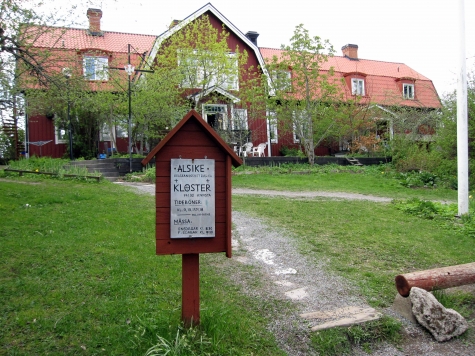
Sisters of the Holy Spirit
The Sisters of the Holy Spirit, located in Alsike, founded their community in 1965. They pray the daily offices found in the Rule of St. Benedict, and are working with the Evangelical Lutheran Church of Kenya to expand there. Their convent, which includes a retreat facility, is located in an old school house next to the parish church. The community also has a group of oblates and friends known as the "Friends of St. Nicholas."

 You can read more about the history of their community at their website (part of which is in English):
http://alsikekloster.org/english/english1.htm
Sisters of Saint Francis
Another community in Sweden is the Sisters of Saint Francis, who have a convent north of Goteborg. Following an adapted version of the Catholic Rule for the Third Order of Saint Francis, the Sisters pray four of the daily offices, and mass is celebrated three times each week.
 If you can read Swedish, or are adept at using the Google translator, you can find out more about their community here:
http://www.klaradalskloster.se/
Other Communities
The "Anglican Religious Life 2014-2015" book lists several other Swedish religious communities, but does not have any information about them other than an address and phone number. They are:
Community of the Holy Trinity, located in Rattvik, Sweden
Mary Magdalene Sisters, located in Nacka, Sweden
Mary Daughters of the Evangelical Mariavagen, located in Enkoping, Sweden
Sankt Sigfrid Sisters, located in Ingelstad, Sweden
The Risen Saviour Sisterhood, located in Stallarholmen, Sweden
If anyone reading this blog knows anything about these communities (or any Lutheran monasteries I have missed on my virtual tour), please share what you know in the comments section, or contact me.
Why am I revisiting the tour now? I just found a list of several more Lutheran monasteries in this book: "Anglican Religious Life 2014-2015" - available here: http://www.amazon.com/Anglican-Religious-Life-2014-15-communities/dp/1848254644/ref=sr_1_1?ie=UTF8&qid=1389667060&sr=8-1&keywords=anglican+religious+life. As you can guess from the title, 99% of the communities described in the book are found within the Anglican Communion, but there is a brief section in the book devoted to communities found in the Church of Sweden, which is linked to the Anglican Communion through the Porvoo Agreement. As I explained during my stop at the Ostanback Monastery in Sweden (http://benedictinelutheran.blogspot.com/2013/06/lutheran-monastery-virtual-tour-stop-3_22.html), the Church of Sweden retained more of the trappings of Catholicism when compared to most other Lutheran churches. Therefore, the re-occurrence of several monastic communities in that country has been a natural outgrowth of their spiritual identity (or what remains of their spiritual identity, anyway).
Sisters of the Holy Spirit
The Sisters of the Holy Spirit, located in Alsike, founded their community in 1965. They pray the daily offices found in the Rule of St. Benedict, and are working with the Evangelical Lutheran Church of Kenya to expand there. Their convent, which includes a retreat facility, is located in an old school house next to the parish church. The community also has a group of oblates and friends known as the "Friends of St. Nicholas."

http://alsikekloster.org/english/english1.htm
Sisters of Saint Francis
Another community in Sweden is the Sisters of Saint Francis, who have a convent north of Goteborg. Following an adapted version of the Catholic Rule for the Third Order of Saint Francis, the Sisters pray four of the daily offices, and mass is celebrated three times each week.

http://www.klaradalskloster.se/
Other Communities
The "Anglican Religious Life 2014-2015" book lists several other Swedish religious communities, but does not have any information about them other than an address and phone number. They are:
Community of the Holy Trinity, located in Rattvik, Sweden
Mary Magdalene Sisters, located in Nacka, Sweden
Mary Daughters of the Evangelical Mariavagen, located in Enkoping, Sweden
Sankt Sigfrid Sisters, located in Ingelstad, Sweden
The Risen Saviour Sisterhood, located in Stallarholmen, Sweden
If anyone reading this blog knows anything about these communities (or any Lutheran monasteries I have missed on my virtual tour), please share what you know in the comments section, or contact me.
Monday, October 21, 2013
Is the Rule of St. Benedict Supported by the Bible?
A common question posed by Protestants about any Christian belief or practice is: "But where is that found in the Bible?" This post is not about the merits (or lack thereof) of sola scriptura (scripture alone); instead, it will set forth a few ways in which the core of the Benedictine way is supported by the Bible.
One verse sums it up: "They devoted themselves to the apostles’ teaching and fellowship, to the breaking of bread and the prayers." (Acts 2:42).
How does that verse relate to the essence of the Rule of St. Benedict? Acts 2:42 can be broken down into three parts: (1) "They devoted themselves to the apostles' teaching and fellowship" - this is found in various Benedictine devotional practices, such as lectio divina ("divine reading"). (2) "The breaking of bread" - the Rule of St. Benedict emphasizes the importance of the Eucharist. (3) "The prayers" - this brief mention needs further explanation, but there is a direct parallel between the pattern of daily prayer used by the first Christians, and the later daily office of prayers set forth in the Rule of St. Benedict.
This note in the Orthodox Study Bible helps explain the reference to "prayers" in Acts 2:42: "Prayers is literally 'the prayers' in Greek, referring to specific liturgical prayers. The Jews had practiced liturgical prayer for centuries, the preeminent prayers being the Psalms. Because the Psalms point so clearly to Christ, Christians immediately incorporated them into (New Testament) worship."
With that background in mind, other Biblical references to the daily liturgical prayers, which were incorporated into the Rule of St. Benedict, become obvious:
"One day Peter and John were going up to the temple at the hour of prayer, at three o’clock in the afternoon." (Acts 3:1). The apostles were praying the mid-afternoon prayers, later referred to by Benedictines as the office of "None".
"In Caesarea there was a man named Cornelius, a centurion of the Italian Cohort, as it was called. He was a devout man who feared God with all his household; he gave alms generously to the people and prayed constantly to God. One afternoon at about three o’clock he had a vision in which he clearly saw an angel of God coming in and saying to him, ‘Cornelius.’ He stared at him in terror and said, ‘What is it, Lord?’ He answered, ‘Your prayers and your alms have ascended as a memorial before God.'" (Acts 10: 1-4 - see also the reference at Acts 10:30). Here, Cornelius is praying the mid-afternoon prayers when he had the encounter with an angel.
"About noon the next day, as they were on their journey and approaching the city, Peter went up on the roof to pray." (Acts 10:9). Noontime prayer in the Rule of St. Benedict is referred to as "Sext".
"About midnight Paul and Silas were praying and singing hymns to God, and the prisoners were listening to them." (Acts 16:25). Here, they were praying the night office of "Vigils" - some monastic orders, such as the Carthusians, still pray at midnight. While most Benedictines have adjusted the time frame, they still pray the night office of prayers.
And how far back does the tradition of praying seven times a day go? At least as far back as the Psalms: "Seven times a day I praise you for your righteous ordinances." (Psalm 119:164).
Sometimes, this daily prayer ritual, observed by the apostles and followed to this day by Benedictines and other orders, is referred to as the "sanctification of time" - the hours of the day are made holy by prayer. For those of us who do not live in a cloister, and who have secular jobs, observing the seven daily prayer offices will not be feasible. However, given the Biblical precedent revealing the importance of regular daily prayer at different times, it should be a goal of all Christians - not just monastics - to figure out a daily prayer regimen that works for them, and follow it.
(Thanks to Matthew Dallman, author of the excellent book "The Benedictine Parish" - reviewed at http://benedictinelutheran.blogspot.com/2013/05/the-benedictine-parish.html - for highlighting the relevance of Acts 2:42 to the Benedictine way).
Monday, October 14, 2013
How to Fight a Zombie Apocalypse
Zombies are all around us!

Halloween is approaching, so signs of the "Zombie Apocalypse" are increasing. The town where I live just had its annual "zombie walk." My son plays in a college marching band, and the theme of their halftime show is the "Zombie Apocalypse." The fourth season of a popular television show ("The Walking Dead" - the story of a post-apocalyptic America overrun by zombies) just began. The DVD of the zombie movie "World War Z" recently topped the sales charts.
The "Zombie Apocalypse" is fictional, of course, but our culture's fascination with a world taken over by the living dead is perhaps another sign that our culture has an unhealthy relationship with the prospect of death, as well as the future of our world. What can we do about this unhealthy relationship?
A simple gesture can help - the sign of the cross.
In my (admittedly limited) experience, I have noticed that Lutherans have recently made the sign of the cross upon themselves much more frequently. Luther wrote that at the beginning of our morning and evening prayers, we should make the sign of the cross, but somewhere along the line, many Lutherans forgot to follow his advice. Increasingly, though, it appears that we are returning to one of the most ancient forms of Christian devotion.
So, how does the sign of the cross help us deal with death and the future of the world? And, just in case there really is a "Zombie Apocalypse", would making the sign of the cross help us against the undead? These words from a Benedictine monk (which would be whole-heartedly endorsed by Luther, I think) help answer those questions:
"This gesture of signing oneself with the cross, like no other gesture, identifies the Christian as a 'Christian', as (one) whose salvation comes solely from Christ's death on the Cross, into which (we have) been drawn in a mysterious manner through the sacrament of baptism. . . .
For this reason the holy sign of the cross, which we make over ourselves or others, is always a profession of faith in the victory that Christ on the Cross won against every hostile power. For the Fathers always made use of this sign, also, whenever they knew that they were confronted with these hostile powers. Indeed, Anthony the Great (one of the Desert Fathers of the early Church) taught his disciples that the demons and phantasms were in reality 'nothing and quickly disappear, especially when a person (is armed) with faith and the sign of the cross.' . . . .
As great as the power of the sign of the cross is, it is not a question of a magical gesture. It is faith that makes it mighty!"
(from pages 181-183 of "Earthen Vessels: The Practice of Personal Prayer According to the Patristic Tradition" by Gabriel Bunge, O.S.B.).
Tuesday, October 8, 2013
Is this Heaven? No, it's Iowa.
Having a rough day? Watch the first few minutes of the video entitled "One Thing" found on the website of New Melleray Abbey, located just outside Dubuque, Iowa. Since the video is not on youtube, I'm not smart enough to figure out how to embed the video here, but its worth clicking on the link:
http://www.newmelleray.org/videos.asp
http://www.newmelleray.org/videos.asp
Friday, October 4, 2013
The Benedictine St. Francis
Today is the day the Church celebrates St. Francis of Assisi. I admit that sometimes when I think about St. Francis, the image that crosses my mind is one of a medieval Dr. Doolittle, wandering around the countryside and taking care of the animals. Based on this icon, I can tell that I am not the only who thinks of that image of St. Francis:

Therefore, I was intrigued by this comment in a review of a new biography of St. Francis:
"Francis cared about the Eucharist, the Daily Office, and poverty much more than he had anything to do with animals or nature. Francis was, contrary to the popular picture of him, a very ecclesial person in both his commitments and in his preoccupations." http://livingchurch.org/francis-and-beyond
Based on that description, St. Francis sounds more like St. Benedict than Dr. Doolittle.
"Most high, omnipotent, good Lord, your servant Francis of Assisi sought to reflect the image of Christ through a life of poverty and humility: Grant your people grace to imitate his joyful love, renounce gladly the vanities of the world, and delight in your whole creation; through Jesus Christ our Lord, who lives and reigns with you and the Holy Spirit, one God, now and forever. Amen."
(From the "New Book of Festivals and Commemorations" by Philip Pfatteicher).
Subscribe to:
Posts (Atom)